
Accounting Beyond a Bachelor's: In-Person at Boston College
Pursuing accounting beyond a bachelor's degree in person at Boston College can accelerate CPA licensure and recruiting. Compare the MSA, costs, and outcomes.

By Benjamin Young
You have finished the bachelor's degree, passed the foundational courses, and now you are staring at a decision that feels larger than any exam you have taken. The accounting profession rewards depth, and the credential that most often signals that depth is the CPA license. In Massachusetts, and specifically at Boston College, the pathway from undergraduate accounting to licensed professional is structured, rigorous, and intentionally personal. The Carroll School of Management offers graduate accounting programs that are delivered in person, on a campus in Chestnut Hill that sits minutes from downtown Boston, one of the densest concentrations of financial services employment in the country. If you are weighing whether to continue your accounting education beyond the bachelor's degree in a face-to-face format at Boston College, this guide walks through the academic options, the licensure mechanics, the career outcomes, and the practical questions you should answer before committing.
Why Boston College for In-Person Accounting Beyond the Bachelor's
Boston College is a private Jesuit research university with an undergraduate and graduate business school that carries strong regional and national recognition. The Carroll School of Management's accounting programs are consistently ranked among the better accounting departments in the Northeast, and the in-person format is not an afterthought. Small cohort sizes, dedicated faculty who maintain professional ties to the Big Four and regional firms, and a campus culture that emphasizes ethics and service all shape the graduate experience. For a student pursuing accounting beyond the bachelor's degree in person at Boston College, the value proposition rests on three pillars: access to faculty who know the profession, proximity to Boston's accounting and finance employers, and a curriculum designed around CPA exam readiness.
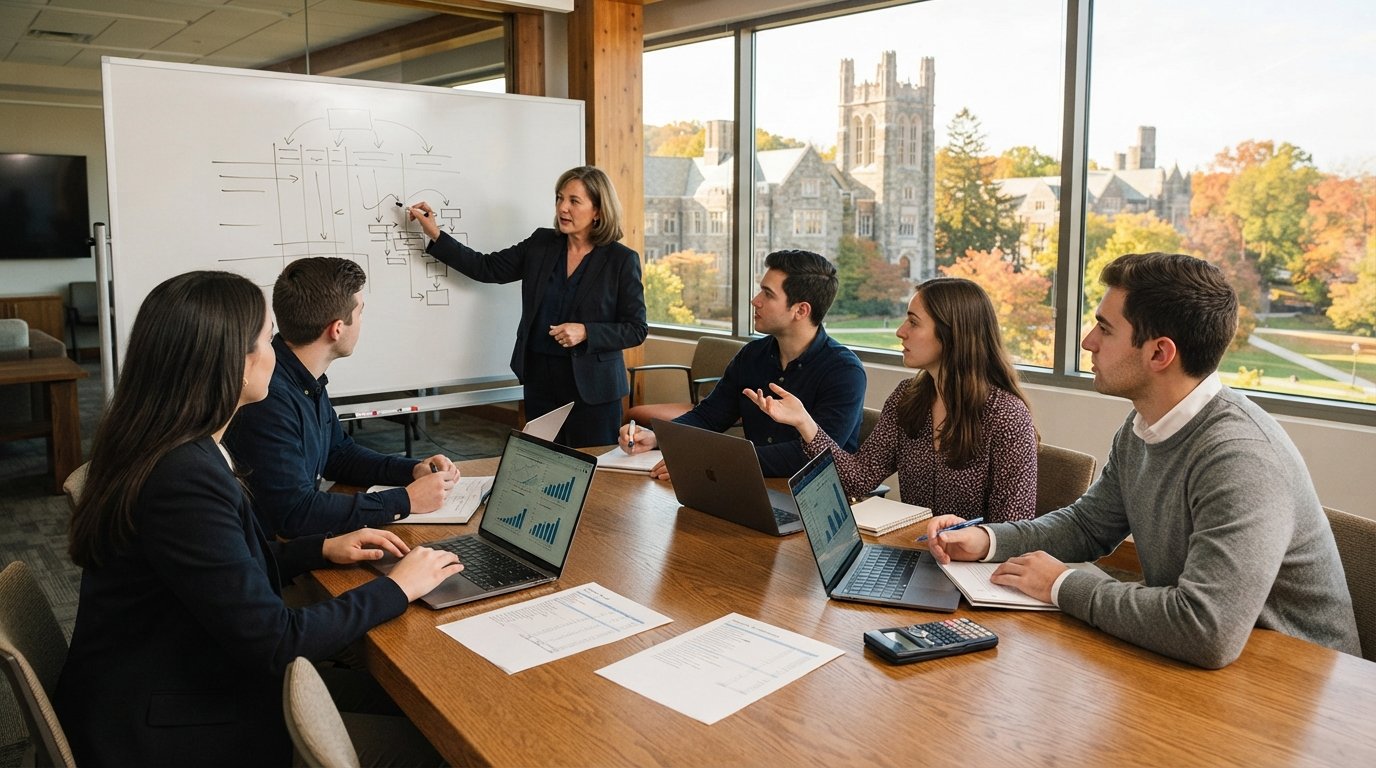
The in-person dimension matters more than some applicants expect. Accounting is a relationship-driven profession. Recruiters from public accounting firms visit campuses, conduct interviews in person, and evaluate candidates partly on presence and communication. A classroom where you present a case study to a partner from a Boston firm, or where a professor connects you to an alum at a mid-sized CPA practice, produces opportunities that asynchronous online formats struggle to replicate. Boston College's location amplifies this: the campus is reachable by public transit from downtown, and the surrounding metro area hosts offices of every major accounting network plus hundreds of regional and boutique firms.
Prospective students often compare formats before committing. Our guide to pursuing a biotechnology master's in person at Barry University illustrates how a face-to-face graduate program can leverage a specific regional industry, and the same logic applies here: Boston College's in-person accounting offerings draw strength from the local professional ecosystem.
Program Options: MSA, MSF, and Certificate Pathways
Boston College's graduate accounting landscape centers on the Master of Science in Accounting (MSA), a program designed for students who have completed an undergraduate accounting degree or its equivalent and want to satisfy the 150-credit-hour requirement for CPA licensure in Massachusetts. The MSA is typically a one-year, full-time, in-person program, though part-time arrangements exist for working professionals. Coursework covers advanced financial accounting, auditing, taxation, and business law, with electives that allow specialization in areas such as forensic accounting or information systems.
Adjacent to the MSA, the Carroll School offers graduate study in finance and related business disciplines. Students whose undergraduate degree is in a different field, or who need additional accounting hours before licensure, often enter through a post-baccalaureate or certificate pathway. These options allow you to complete the specific accounting and business courses required by the Massachusetts Board of Public Accountancy without enrolling in a full master's program. The right choice depends on how many credits you already hold and how quickly you want to sit for the CPA exam.
Here is how the main pathways compare for a student moving beyond the bachelor's degree in accounting at Boston College:
- MSA (Master of Science in Accounting): One-year, full-time, in-person cohort program; ideal for accounting majors who need 150 credit hours and want structured recruiting.
- Post-baccalaureate accounting coursework: Flexible, course-by-course enrollment for students who need specific prerequisite or licensure courses but not a full degree.
- MSF or broader business master's: For students who want accounting depth combined with finance or analytics training, often useful for corporate finance or advisory roles.
- Certificate options: Short, focused sequences for professionals adding a credential without committing to a full graduate degree.
Each pathway carries different cost, duration, and recruiting implications. The MSA commands the highest investment but offers the most direct pipeline into public accounting and the strongest alumni network for job placement. The post-baccalaureate route is leaner and faster for students who already have most of the accounting hours but are missing a few upper-level courses. The MSF and certificate options serve narrower goals, such as transitioning into financial analysis or satisfying continuing education requirements.
The 150-Hour Requirement and CPA Licensure in Massachusetts
Massachusetts, like most states, requires CPA candidates to complete 150 semester credit hours of education before licensure, including a minimum number of accounting and business courses. A typical bachelor's degree delivers roughly 120 credits, which leaves a gap of about 30 credits. That gap is the practical reason most accounting students pursue education beyond the bachelor's degree. Boston College's MSA is built to close it in one academic year, but the requirement can also be met through a combination of undergraduate overload, community college courses, and post-baccalaureate study.
The sequence matters. To sit for the CPA exam in Massachusetts, you generally need to have completed the educational requirements or be within a specified number of credits of completion, depending on the current board rules. Most students at Boston College take a hybrid approach: they apply to the MSA during their senior year, begin the program in the fall, and sit for one or two exam sections during the spring semester while finishing coursework. The in-person format supports this because faculty and advising staff coordinate around the exam calendar and because study groups form naturally within the cohort.
Licensure also requires passing all four sections of the Uniform CPA Examination and completing at least one year of supervised professional experience, which in Massachusetts can be obtained before, during, or after the exam process depending on the pathway. The education piece is the one you control most directly, and it is where the decision between Boston College's in-person graduate programs and other options becomes consequential. Careful sequencing of courses, exam sections, and job start dates can compress the timeline by six to twelve months.
Admissions, Cost, and Financial Planning
Admission to Boston College's graduate accounting programs is competitive but not opaque. The MSA program looks for a strong undergraduate GPA, completion of core accounting courses such as intermediate financial accounting and auditing, and evidence of professional motivation. GMAT or GRE scores are considered, though the school has moved toward more holistic review in recent cycles. Application materials typically include transcripts, a resume, essays, and letters of recommendation, with deadlines in the fall and early spring for the following academic year.
Cost is a legitimate concern, and prospective students should build a realistic budget before applying. Graduate tuition at a private university in the Boston area is substantial, and living expenses in Chestnut Hill and surrounding neighborhoods add meaningfully to the total. However, several offsets exist: merit scholarships awarded by the Carroll School, graduate assistantships that provide stipends or tuition remission, employer tuition benefits for students already working in accounting or finance, and federal loans. Public accounting firms sometimes offer signing bonuses or reimbursement arrangements for graduate study, particularly for candidates who commit to a start date before enrolling.
Financial planning should also account for the opportunity cost of a year without full-time earnings. Students who compare the MSA against a lower-cost online or part-time option should weigh the difference in recruiting access, not just tuition. Boston College's in-person program places graduates into Big Four, national, and regional firms at rates that often justify the premium, but the calculation is personal and should include your target employer, geography, and timeline. Prospective students exploring a range of sponsored campus and online programs can compare options through HigherEducationAdvisor's college matching resources before finalizing a shortlist.
Career Outcomes and Recruiting Through Boston College
The strongest argument for pursuing accounting beyond the bachelor's degree in person at Boston College is the recruiting machine that surrounds the program. The Carroll School operates a dedicated career services team for graduate business students, and accounting firms recruit on campus each fall. The typical cycle includes firm presentations, networking events, interviews, and offers extended before the winter holidays. Students who enter the MSA in the fall often have internship or full-time offers in hand by early spring.
Graduates pursue several broad paths. Public accounting remains the most common destination, with placements at the Big Four, national firms such as RSM and Grant Thornton, and Boston-area regional practices. Corporate accounting roles in financial services, healthcare, technology, and higher education are also common, particularly for students who prefer a more predictable schedule. A smaller share of graduates move into advisory, forensic accounting, or tax specialization, sometimes after a few years in audit. The in-person format supports these outcomes because interviews, office visits, and alumni networking happen face to face, and because the Boston market is dense enough that students can attend multiple firm events in a single week.
Salary outcomes vary by firm and role, but entry-level public accounting compensation in the Boston market has risen steadily and now typically falls in a range that makes the graduate investment recoverable within a few years. Students who combine the MSA with a strong undergraduate record and relevant internships often enter at the higher end of that range. The alumni network is another durable asset: Boston College accounting graduates populate firms across the Northeast and maintain active engagement with the school, which matters when you are seeking a referral or considering a lateral move five or ten years into your career.
Making the Decision: Questions to Ask Before You Commit
Before you submit a deposit, work through a structured set of questions about fit, timing, and return on investment. The answers will differ for every applicant, but the questions themselves are consistent. Asking them early prevents costly detours and helps you compare Boston College's in-person program against alternatives with clear eyes.
- How many accounting credits do I already hold, and how many do I need for licensure? Request a transcript review from the program before applying so you know exactly which courses you still need.
- What is my target employer and timeline? If you want Big Four public accounting, the fall recruiting cycle should drive your application timing. If you want corporate accounting, the calculus may differ.
- Can I afford the full cost, including living expenses, without excessive borrowing? Build a budget that includes tuition, fees, housing, transportation, and exam preparation costs.
- Does the in-person format fit my life? A one-year full-time program requires relocation or a manageable commute; part-time options exist but extend the timeline.
- What scholarship, assistantship, or employer support can I access? Apply for merit aid early and ask your current employer about tuition benefits before assuming you will pay full price.
These questions also help you evaluate whether a different format or institution might serve you better. Boston College's in-person MSA is an excellent fit for students who want structured recruiting, proximity to a major accounting market, and a cohort experience. It is a weaker fit for students who cannot relocate, who already have most of the credits they need, or who prioritize the lowest possible cost over recruiting access. Being honest about which category you fall into will save time and money.
Beyond the Classroom: Campus Resources and Professional Development
The value of an in-person program extends past the syllabus. Boston College's graduate accounting students have access to the Carroll School's career center, alumni mentoring programs, and student organizations focused on accounting and finance. These resources are not unique to Boston College, but their density and quality are shaped by the school's size and its relationship with the profession. A mentoring match with an alum at a Boston firm, for example, can turn into an internship referral or a mock interview that sharpens your recruiting performance.
Professional development also happens informally. Study groups that form in the first weeks of the MSA often become the support system that carries students through the CPA exam. Cohort social events, firm-sponsored dinners, and case competitions build the soft skills that public accounting firms evaluate during interviews. Students who treat the program as a full-time professional launch, not just a set of courses, tend to extract more from it. That means attending firm events even when you are busy, joining the accounting student association, and cultivating relationships with faculty who can write meaningful recommendations later.
For students who are still exploring the broader landscape of graduate and professional programs, matching services can help narrow the field by format, subject, and location. TopStudents.com connects prospective students with sponsored college listings and lets you request information from programs without any obligation to apply or enroll, which is a useful first step before committing to a specific school or pathway.
Accounting beyond the bachelor's degree in person at Boston College is a serious investment of time and money, and it is best suited to students who want the structure, recruiting access, and professional network that a campus-based graduate program provides. If you have the credits, the timeline, and the target employer in mind, the program can compress years of career uncertainty into a focused twelve months. If you do not, the same research process will point you toward a leaner or more flexible alternative. Either way, the decision is clearer once you know the licensure rules, the program mechanics, and your own priorities.