
Biological and Physical Sciences Associate's Degree at BCC
Earn a Biological and Physical Sciences Associate's degree, usually 2 years In-person at Berkshire Community College, and transfer to a bachelor's with hands-on lab skills.

By Sasha Rublev
Choosing a college program that balances hands-on science with a clear path to a bachelor's degree or entry-level career is a decision that shapes the next several years of your life. The Biological and Physical Sciences Associate's degree, usually 2 years In-person at Berkshire Community College, offers a focused, laboratory-rich route for students who want a strong foundation in biology, chemistry, physics, and mathematics before transferring or entering the workforce. Berkshire Community College, located in Pittsfield, Massachusetts, has built this program around small classes, accessible faculty, and transfer agreements that help graduates move smoothly into four-year institutions.
If you are comparing associate degrees in the sciences, understanding what this specific program includes, who it suits, and how to enroll can save you time and money. This guide walks through the curriculum, admission steps, costs, transfer options, and career outcomes so you can decide whether this in-person science degree aligns with your goals. Along the way, you will also see how a college matching service such as TopStudents.com can help you compare similar programs by subject and state.
What the Biological and Physical Sciences Associate's Degree Covers
The Biological and Physical Sciences Associate's degree at Berkshire Community College is an interdisciplinary program. Instead of specializing narrowly in one science, you build a broad base across the life sciences and the physical sciences. That means you take courses in general biology, general chemistry, organic chemistry, physics, and calculus or statistics, depending on your transfer target. The program is designed so that the credits you earn map cleanly onto the first two years of many bachelor's degrees in biology, chemistry, environmental science, and health-related fields.
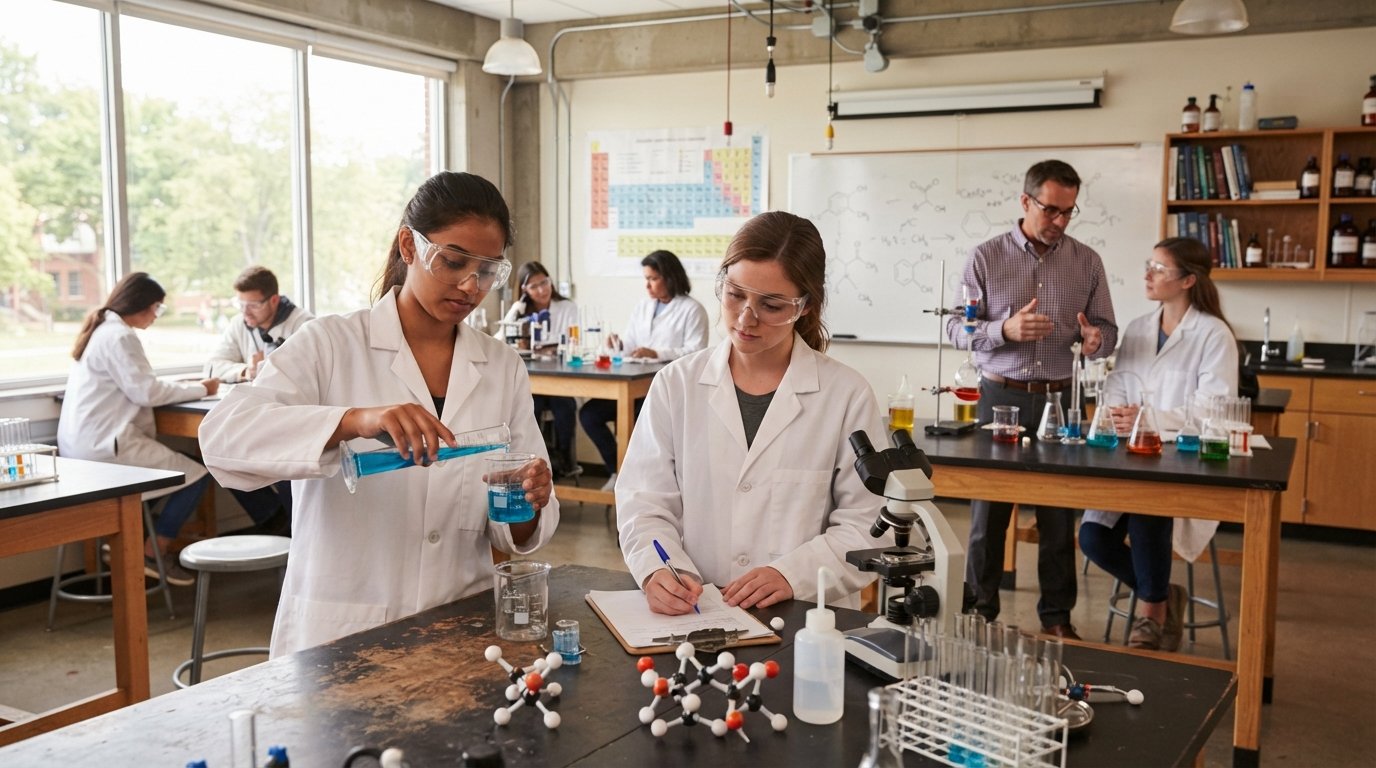
Because the degree is delivered in person, you spend substantial time in laboratories. You learn how to use microscopes, prepare chemical solutions, record experimental data, and write lab reports. These hands-on skills are difficult to replicate fully online, and they are exactly what four-year science programs and employers expect from transfer students. Small class sizes at Berkshire Community College mean you can ask questions during lab and get feedback from instructors who know your name.
The program typically requires around 60 to 64 credits, which is standard for a two-year associate degree. Full-time students who follow the recommended sequence can finish in four semesters. Part-time students often take three or more years, especially if they balance work or family responsibilities. Either way, the structure is flexible enough to accommodate different schedules while keeping the science sequence intact.
Core Science and Math Requirements
Most students in this program complete a set of foundational courses that include two semesters of general biology with lab, two semesters of general chemistry with lab, and at least one semester of physics. Calculus I and II or a combination of calculus and statistics are usually required, depending on the transfer school. You also take English composition and a few social science or humanities electives to satisfy general education requirements. This mix ensures you are not only scientifically literate but also prepared for upper-level writing and critical thinking.
Organic chemistry is often part of the second year for students planning to pursue pharmacy, medical laboratory science, or pre-med tracks. If your goal is environmental science or geology, you might substitute additional earth science or physics courses. Academic advisors at Berkshire Community College help you choose electives that align with your intended bachelor's degree, which reduces the risk of losing credits after transfer.
Laboratory and Research Skills
Laboratory work is not an add-on in this program; it is central. In biology labs, you might culture cells, examine plant anatomy, or conduct enzyme assays. In chemistry labs, you learn titration, spectroscopy, and safe handling of reagents. Physics labs cover mechanics, electricity, and optics. These experiences build a portfolio of practical skills that you can describe in job interviews or scholarship applications.
Some students also pursue independent research or internship opportunities with local organizations. Berkshire County has a growing life sciences and healthcare presence, and faculty sometimes connect students with labs, hospitals, or environmental agencies. Even a single semester of applied research can strengthen your transfer application and clarify your career direction.
Why Choose an In-Person Science Degree at Berkshire Community College
Online science degrees have improved, but laboratory science still benefits from face-to-face instruction. When you enroll in the Biological and Physical Sciences Associate's degree, usually 2 years In-person at Berkshire Community College, you get access to equipment, safety supervision, and immediate feedback that online simulations cannot fully replace. For students aiming at medical school, pharmacy school, or competitive bachelor's programs, that hands-on experience matters.
Another advantage is cost. Community college tuition is significantly lower than four-year public or private university tuition, especially for Massachusetts residents. You can complete your first two years of a science degree for a fraction of the cost and then transfer to a four-year school to finish your bachelor's. This strategy can reduce total student loan debt and make graduate school more financially feasible later.
Berkshire Community College also offers support services that help science students succeed: tutoring, study groups, and transfer advising. Because the campus is in Pittsfield, students from across Berkshire County and nearby New York and Connecticut can commute. The in-person format also builds a community of peers who study together and encourage each other through challenging courses like organic chemistry and calculus.
If you are still exploring options, a resource like General Studies Associate's Degree at CGCC can show you how other two-year programs compare, which helps you weigh a focused science degree against a broader general studies path.
Admission Requirements and Application Steps
Berkshire Community College maintains an open-access admission policy for most associate degree programs, but science programs may have specific placement requirements in math and English. You typically need a high school diploma or equivalent, and you may need to take placement tests or submit SAT, ACT, or Accuplacer scores to determine which math and English courses you start with. Strong performance in high school algebra, biology, and chemistry is helpful but not mandatory.
Here is a simplified sequence for applying:
- Complete the online application for Berkshire Community College and select Biological and Physical Sciences as your intended program.
- Submit official high school transcripts or GED scores, plus any college transcripts if you have prior credits.
- Take placement assessments in math and English, or provide qualifying test scores.
- Meet with an academic advisor to plan your first-semester courses and discuss transfer goals.
- Apply for financial aid by completing the FAFSA and explore scholarships through the college foundation.
After you are admitted, you register for classes during the college's registration window. Science courses fill quickly, so early registration is recommended. If you need developmental math or English, you may take those courses first and still finish the science sequence within two to three years.
International students and out-of-state students should check additional requirements, including visa documentation and tuition rates. Because this program is in person, international students can maintain F-1 status while studying on campus.
Costs, Financial Aid, and Return on Investment
Tuition at Massachusetts community colleges is set by the state and is generally lower than at four-year institutions. For the 2025-2026 academic year, in-state students at Berkshire Community College can expect to pay several thousand dollars per year in tuition and fees, plus books and supplies. Out-of-state tuition is higher. Living expenses depend on whether you commute from home or rent nearby.
Financial aid options include federal Pell Grants, Massachusetts state grants, work-study, and institutional scholarships. The FAFSA is the primary application for need-based aid. Many science students also qualify for STEM scholarships from private foundations or professional organizations. Because the associate degree is only two years, the total cost is manageable compared to four years at a university.
From a return-on-investment perspective, graduates who transfer to a four-year school and complete a bachelor's in a STEM field often see strong starting salaries. Laboratory technicians, research assistants, and entry-level environmental scientists typically earn competitive wages, and the associate degree alone can qualify you for some technician roles. If you continue to a bachelor's or professional degree, the earnings potential rises significantly.
To compare costs and program formats across different schools, you can use a matching service that lets you browse sponsored listings by subject and state. For example, CheapOnlineEducation helps prospective students explore online and campus degree options and connect with participating schools, which can be useful when you want to see how Berkshire Community College stacks up against other science programs. TopStudents.com works in a similar way, allowing you to request information from schools with no obligation to apply or enroll.
Transfer Pathways and Bachelor's Degree Options
One of the strongest features of the Biological and Physical Sciences Associate's degree is its transferability. Berkshire Community College has articulation agreements with several Massachusetts public universities, including the University of Massachusetts system and Massachusetts College of Liberal Arts. These agreements specify which courses transfer and how the associate degree fulfills general education requirements.
Students commonly transfer into bachelor's programs in biology, chemistry, biochemistry, environmental science, public health, and nursing. Some pursue pre-professional tracks for medical, dental, or veterinary school. Because the associate degree includes the first two years of science and math, you enter your bachelor's program as a junior, provided you choose courses that match the receiving institution's requirements.
Transfer advising is critical. Advisors at Berkshire Community College help you select electives that satisfy both the associate degree and the bachelor's program. They also help you apply for transfer scholarships and meet deadlines. If you plan carefully, you can avoid losing credits and finish your bachelor's in two additional years.
For students who want to stay in the region, some four-year schools offer evening or hybrid completion programs. Others may offer online upper-level courses, though the first two years of lab science are best done in person. The combination of an in-person associate degree and a flexible bachelor's completion can be both affordable and practical.
Career Outcomes and Further Study
Graduates with an associate degree in biological and physical sciences can pursue several entry-level positions. Common job titles include laboratory technician, quality control assistant, environmental sampling technician, and pharmacy technician (with additional certification). These roles exist in hospitals, research labs, pharmaceutical companies, environmental consulting firms, and manufacturing.
Many graduates, however, use the degree as a stepping stone. A bachelor's degree opens doors to roles such as research associate, microbiologist, chemist, or science teacher. A master's or doctoral degree leads to independent research, college teaching, or leadership in biotechnology and healthcare. The associate degree provides the foundation and the confidence to continue.
According to the U.S. Bureau of Labor Statistics, occupations in life, physical, and social science are projected to grow faster than average over the next decade. Jobs for environmental scientists, biochemists, and medical scientists are expected to increase as technology and healthcare expand. Starting early with a community college science degree positions you to take advantage of that growth.
How to Succeed in the Program
Science courses are demanding, but success is achievable with the right habits. Attend every lab, form study groups, and use tutoring services. Meet with professors during office hours, especially before exams. Keep your math skills sharp, because calculus and statistics appear throughout the science curriculum. Manage your time carefully, and avoid overloading your schedule with too many lab courses in one semester.
If you work while studying, consider taking three courses per semester instead of five. It may take longer, but your grades and understanding will improve. Communicate with your advisor about your goals, and update your transfer plan each semester. Finally, apply for scholarships early and often; many awards go unused because students do not apply.
Berkshire Community College also offers academic support centers, computer labs, and library resources. Use them. The in-person format means you have access to a campus community that wants you to succeed. Take advantage of it.
The Biological and Physical Sciences Associate's degree, usually 2 years In-person at Berkshire Community College, is a smart choice for students who want a rigorous, affordable, and transfer-friendly science education. With small classes, hands-on labs, and strong advising, it prepares you for a bachelor's degree or an entry-level science career. If you are ready to explore your options, use a college matching service to compare programs and request information from schools that fit your goals. There is no obligation to apply or enroll, so you can research with confidence and take the next step when you are ready.