
Civil Engineering Bachelor's at ASU: 4-Year Campus Program
Explore ASU's 4-year, in-person Civil Engineering bachelor's degree, ABET-accredited with hands-on learning and strong career outcomes.

By Diana Tillotson
Civil engineering shapes the world around you, from the roads you drive on to the water you drink. If you are ready to design infrastructure that lasts generations, the Civil Engineering, General Bachelor's degree, usually 4 years In-person at Arizona State University Campus Immersion offers a direct path. This program combines rigorous technical training with hands-on projects, placing you in the heart of one of the fastest-growing regions in the United States. But before you commit, you need a clear picture of what this degree involves, how it prepares you for licensure, and what career doors it opens. This guide walks you through the curriculum, the campus experience, and the outcomes you can expect from ASU's Ira A. Fulton Schools of Engineering.
Choosing where to earn your engineering degree is as critical as choosing the field itself. ASU's campus immersion model means you will learn in physical classrooms and labs, not behind a screen. You will collaborate with peers on team-based design challenges, use industry-standard software, and build a professional network with professors and visiting engineers. For many students, this in-person environment is the difference between merely learning theory and actually understanding how to apply it. The program is accredited by ABET, which is essential for your future as a professional engineer. Accreditation ensures the curriculum meets the high standards required for licensure, and ASU's program has a long history of producing graduates who excel in the field.
What Makes ASU's Civil Engineering Program Unique
Arizona State University has redefined what a modern engineering education can be. The Civil Engineering program at the Tempe campus is not just about textbooks and exams; it is about solving real problems. You will have access to cutting-edge research centers like the Center for Smart Cities and the Arizona Center for Algae Technology and Innovation, which may sound niche, but they expose you to the future of sustainable infrastructure. The faculty are not just educators; they are active researchers who bring grant-funded projects into the classroom, giving you opportunities to participate in studies that address water scarcity, resilient materials, and transportation systems.
The curriculum is structured to build your knowledge progressively. Your first two years focus on foundational sciences: calculus, physics, chemistry, and introductory engineering courses. You will also dive into statics, dynamics, and mechanics of solids, which are the building blocks of all structural work. In your junior and senior years, you specialize through technical electives. You can choose to focus on structural engineering, transportation systems, water resources, geotechnical engineering, or construction management. This flexibility allows you to tailor your degree to your career aspirations, whether you dream of designing skyscrapers or improving highway safety.
Accreditation and Licensure Preparation
One of the most important aspects of any engineering degree is its accreditation. ASU's Civil Engineering program is accredited by the Engineering Accreditation Commission of ABET. This accreditation is your assurance that the program meets the national standards for quality and rigor. It also simplifies the path to professional licensure, which is a two-step process in most states. First, you take the Fundamentals of Engineering (FE) exam, which is typically taken during your senior year or shortly after graduation. Passing this exam makes you an Engineer in Training (EIT). After four years of professional experience under a licensed engineer, you are eligible to take the Principles and Practice of Engineering (PE) exam. ASU's curriculum is specifically designed to prepare you for these exams, covering the breadth of topics you will be tested on.
Many students worry about the cost of a four-year degree. While ASU's tuition is competitive for an in-state public university, out-of-state students will pay more. You should always explore scholarship opportunities, financial aid, and the Western Undergraduate Exchange (WUE) program if you are a resident of a participating state. The financial investment is substantial, but the return on investment for civil engineers is strong. According to the U.S. Bureau of Labor Statistics, the median annual wage for civil engineers was over $89,000 in 2022, and the field is projected to grow by 5% from 2022 to 2032, which is faster than the average for all occupations. This growth is driven by the need to repair aging infrastructure and adapt to climate change.
Core Curriculum and Specializations
During your four years at ASU, you will complete a series of core engineering courses that lay the groundwork for your specialization. The first year includes introductory engineering design, where you work in teams to solve open-ended problems. This course teaches you the engineering design process, from identifying constraints to presenting your final solution. You will also take calculus and physics, which are the mathematical language of engineering. By your sophomore year, you will be immersed in civil engineering-specific courses. These include:
- Statics and Dynamics: Understanding forces on stationary and moving objects.
- Mechanics of Materials: Analyzing how structures deform under stress.
- Fluid Mechanics: Studying the behavior of liquids and gases, critical for water resources.
- Structural Analysis: Learning how to calculate loads on beams, columns, and frames.
- Geotechnical Engineering: Understanding soil properties and their interaction with structures.
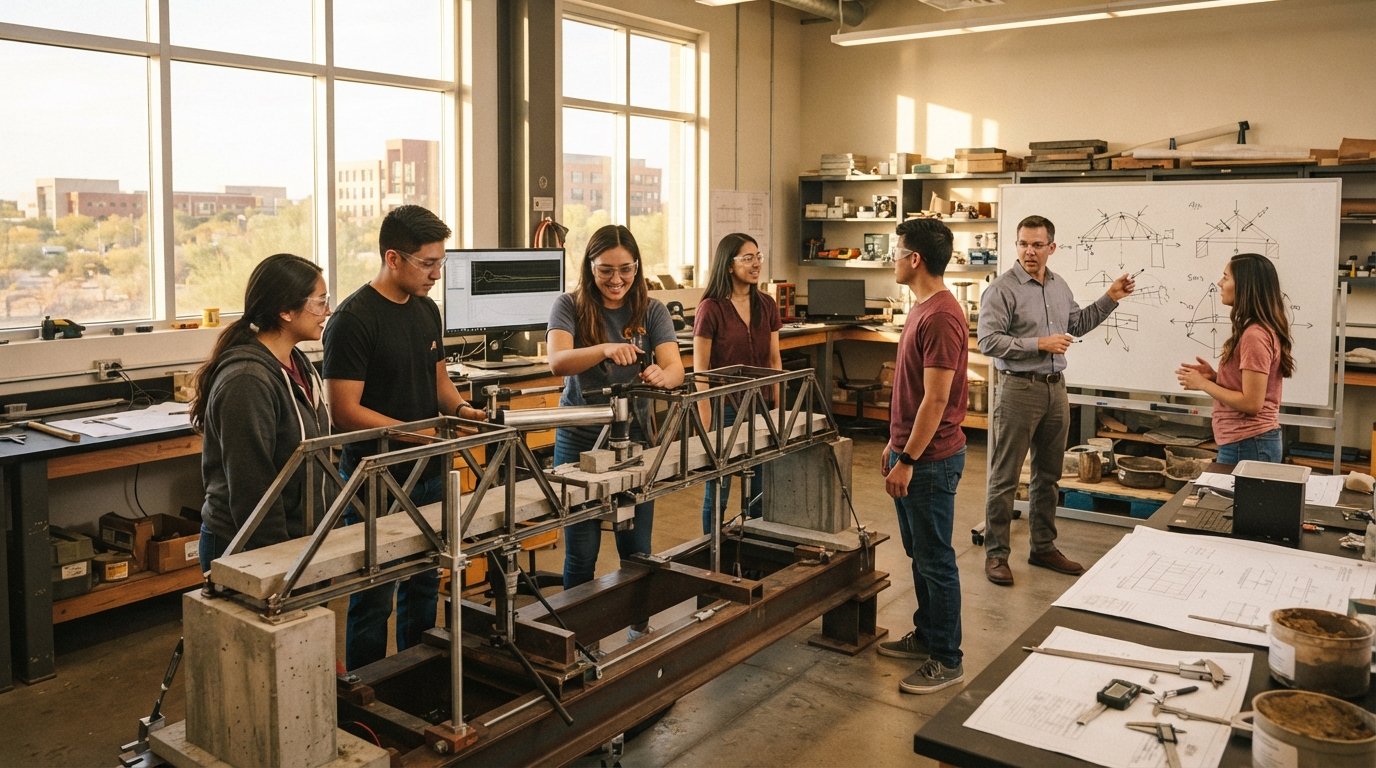
These courses are challenging but essential. You will spend hours in the lab conducting experiments on concrete cylinders, testing soil samples, and measuring flow rates. This hands-on experience is invaluable because it reinforces the theoretical concepts you learn in lectures. For example, in my own undergraduate years, the moment I tested a concrete beam to failure in the lab, I truly understood the stress-strain curve that had seemed so abstract in class. That is the kind of learning environment ASU fosters.
After completing the core, you select a specialization area. If you choose structural engineering, you will take courses in steel and reinforced concrete design, bridge engineering, and earthquake-resistant structures. If transportation is your passion, you will study traffic flow theory, pavement design, and urban transportation planning. Water resources students dive into hydrology, hydraulic engineering, and groundwater remediation. Construction management students learn about project scheduling, cost estimation, and legal aspects of construction. This specialization is your chance to become an expert in a field that interests you deeply.
Hands-On Learning and Internships
ASU places a strong emphasis on experiential learning. The capstone design course is a highlight of the senior year, where you work in a team to design a complete civil engineering project. Past projects have included designing a bridge for a local municipality, developing a stormwater management plan for a new development, and creating a sustainable transportation network for a campus expansion. You will not just perform calculations; you will prepare a professional report and present your design to a panel of faculty and industry professionals. This experience mirrors what you will do in your career, making you job-ready from day one.
Internships are not required, but they are highly recommended and heavily supported. ASU's career services office hosts career fairs twice a year, where you can meet recruiters from companies like Burns & McDonnell, HDR, Jacobs, and the Arizona Department of Transportation. Many students complete internships during the summer after their junior year, and a significant number receive full-time job offers from their internship employers. These internships provide a taste of professional life and help you decide which sector of civil engineering you want to work in: private consulting, public agencies, or construction firms. You can also participate in research with faculty, which is excellent preparation for graduate school or a career in R&D.
Career Outcomes and Further Study
Graduates of ASU's Civil Engineering program are in high demand. The average starting salary for recent graduates is around $70,000, with many earning more depending on their specialization and location. Over time, with experience and licensure, salaries can exceed $100,000, especially for those who move into project management or senior engineering roles. You will find ASU alumni working at top engineering firms across the country, as well as in government agencies like the Federal Highway Administration and the U.S. Army Corps of Engineers. The degree is versatile, allowing you to work in construction, consulting, or even tech companies that need infrastructure experts.
If you are interested in research or advanced technical roles, a bachelor's degree is not the end of the road. Many ASU graduates pursue master's degrees in civil engineering or related fields like environmental engineering or urban planning. A master's degree can open the door to specialized roles in areas like earthquake engineering or water resource management, often leading to higher salaries and more responsibility. ASU also offers accelerated programs that allow you to earn both a bachelor's and a master's degree in five years, saving you time and money. For those considering this path, it is wise to plan early and talk to your academic advisor about your options.
Before you make a final decision, consider how this program fits your long-term goals. If you are comparing programs, you might also look at other on-campus options. For instance, a Religion Bachelor's Degree at Colgate provides a different kind of four-year residential experience, but if you are committed to engineering, ASU's immersion is hard to beat. The campus itself is a living laboratory for civil engineering, with ongoing construction projects, smart infrastructure, and a rapidly growing metropolitan area surrounding it. You will be learning in a place where the principles you study are being applied daily.
To get a sense of the program's culture, visit the campus if you can. Sit in on a class, talk to current students, and walk through the engineering buildings. You will see students collaborating on projects, using 3D printers in the maker spaces, and preparing for design competitions. That energy is infectious. If you cannot visit in person, take advantage of online information sessions and virtual tours. ASU also boasts a robust alumni network, and you can connect with alumni in your desired field through LinkedIn or the university's mentorship platform. These conversations can provide invaluable insights into the program's strengths and challenges.
One crucial aspect to understand is the difference between general and specialized civil engineering degrees. At ASU, you earn a Bachelor of Science in Civil Engineering, which is considered a general degree because it covers all subdisciplines. This is advantageous because it gives you a broad foundation, making you flexible in the job market. You can always specialize later through your electives, projects, and first job. This breadth is why ABET-accredited general civil engineering programs are so valued by employers. They know you can adapt to any project, whether it involves structures, water, or transportation.
Financial considerations are real, but do not let them deter you without exploring every avenue. ASU offers merit-based scholarships for incoming freshmen, and you should complete the Free Application for Federal Student Aid (FAFSA) to see if you qualify for grants or loans. Also, look into work-study programs and on-campus jobs within the engineering school. Working as a lab assistant or research aide not only earns money but also deepens your understanding of the material. Many students find that these positions become their first professional reference.
The decision to pursue this degree is a commitment to a demanding but rewarding career. Civil engineers play a vital role in society, ensuring that communities have safe water, reliable transportation, and resilient buildings. The work is not always glamorous, but it is profoundly impactful. When you drive over a bridge you helped design, or see a water treatment plant you worked on providing clean water to a city, you will feel a sense of accomplishment that few other careers can match.
How to Apply and What to Expect
Applying to ASU is straightforward. You can submit your application online through the university's admissions portal. The requirements include your high school transcripts, standardized test scores (though ASU is test-optional for many applicants), and a personal statement. For engineering programs, strong grades in math and science are crucial. ASU has a rolling admissions policy, but you should apply early, especially if you are applying for scholarships or honors programs. The fall semester is the most common entry point, but ASU also offers spring and summer starts, which can be beneficial if you need more flexibility.
Once you are accepted, you will go through orientation, where you will register for classes and meet your academic advisor. You will be assigned a faculty mentor who can guide you on course selection and career planning. The first year can be challenging as you adjust to the pace of college and the rigor of engineering courses. Do not hesitate to use the university's tutoring services and academic success workshops. Forming study groups with your peers is one of the most effective strategies. You are not competing against each other; you are all future colleagues, and learning to work together is part of the education.
ASU's campus immersion experience extends beyond the classroom. You will have access to over 1,000 student organizations, including the American Society of Civil Engineers (ASCE) student chapter. Joining ASCE gives you opportunities to participate in regional and national competitions, such as the concrete canoe or steel bridge competitions. These competitions are intense and rewarding, testing your design and project management skills. They also look great on your resume. You will also have opportunities to attend guest lectures by leading engineers, attend career workshops, and network at industry events.
In summary, the Civil Engineering, General Bachelor's degree, usually 4 years In-person at Arizona State University Campus Immersion is more than just a degree; it is a launchpad for a lifelong career. The combination of a strong ABET-accredited curriculum, world-class faculty, and a dynamic campus environment prepares you to hit the ground running after graduation. You will leave not only with technical knowledge but also with the professional skills and confidence to lead projects and teams. The investment of time and money is significant, but the return in terms of career stability, intellectual challenge, and societal contribution is immense.
For additional resources on comparing engineering programs and understanding your options, you can visit HigherEducationAdvisor, which provides tools to explore sponsored degree listings and request more information. As you make your decision, remember that the right program for you is one that challenges you, supports you, and aligns with your career goals. For many future civil engineers, ASU's on-campus program fits that bill perfectly. Take the next step, explore what the university has to offer, and imagine yourself building the future.