
CNC Machinist Certificate at Community College of Rhode Island
Start a high-demand manufacturing career in under a year with this hands-on CNC Machinist Certificate at the Community College of Rhode Island.

By Diana Tillotson
Precision manufacturing drives the modern world, from the components in your car's engine to the surgical instruments in a hospital. At the heart of this industry are computer numerically controlled (CNC) machinists, skilled professionals who program, operate, and maintain the machines that produce everything from aerospace parts to consumer goods. If you are looking for a fast, hands-on pathway into this high-demand trade, the Computer Numerically Controlled (CNC) Machinist Technology/CNC Machinist Certificate, 12 weeks to less than 1 year In-person at Community College of Rhode Island stands out as a focused, practical launching point. This program is designed for individuals who want to move from the classroom to the shop floor in record time, gaining the skills employers actively seek.
In this article, we will break down exactly what this certificate entails, why it matters for your career, and how you can determine if it is the right educational investment for your future. We will cover the curriculum, the skills you will master, the job market, financial aid options, and the application process. By the end, you will have a clear picture of whether this accelerated, in-person training path aligns with your professional goals.
Why Choose an In-Person CNC Machinist Certificate?
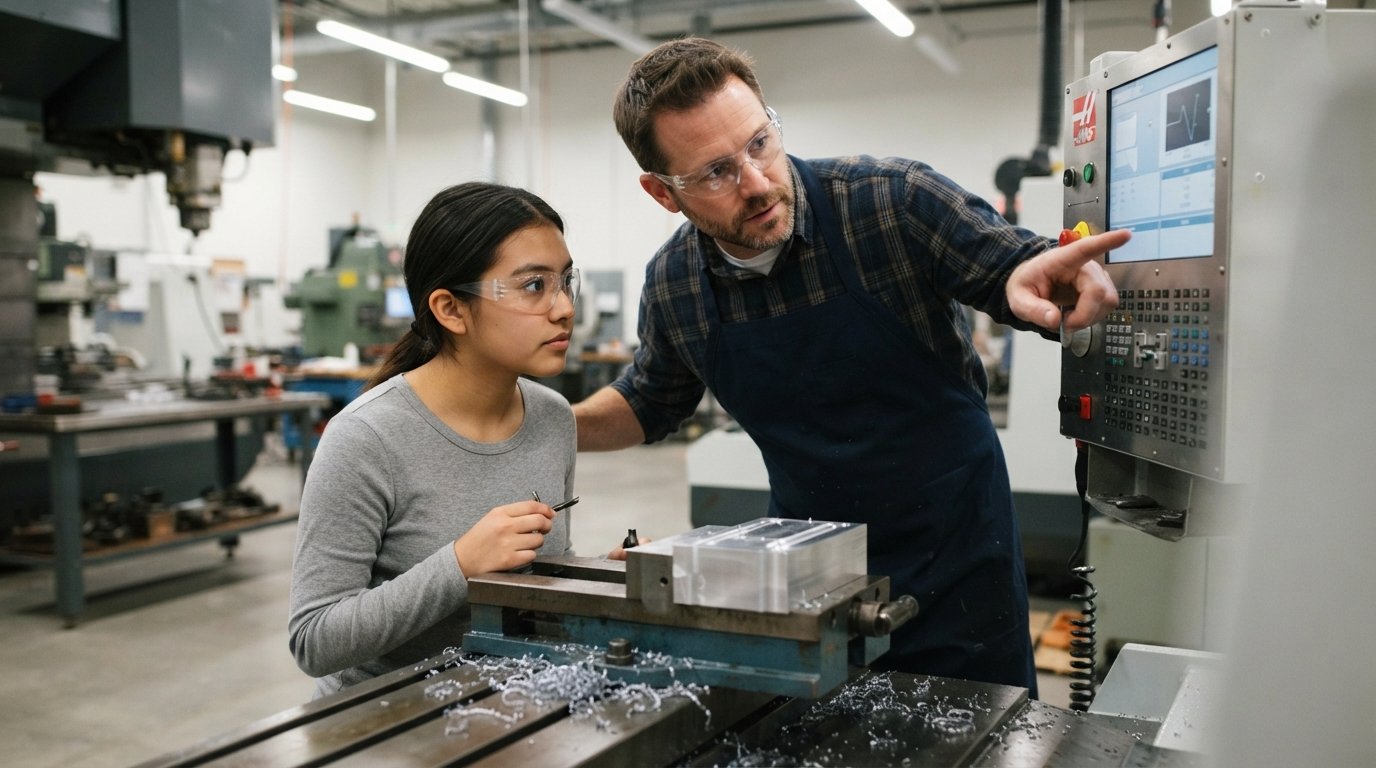
Choosing between online and on-campus training is one of the first decisions you will face. For CNC machining, the in-person format is not just a preference; it is a necessity. Unlike purely theoretical subjects, machining is a tactile skill. You need to feel the vibration of the cutter, hear the change in sound as the tool engages the metal, and see the chips form to understand how adjustments affect the final part. The Computer Numerically Controlled (CNC) Machinist Technology/CNC Machinist Certificate, 12 weeks to less than 1 year In-person at Community College of Rhode Island provides you with direct access to industrial-grade equipment, experienced instructors, and a learning environment that mimics a real production floor.
Learning in person allows you to receive immediate feedback. When you are setting up a machine or writing a program, errors can be costly. In a classroom setting, instructors can catch a mistake before it becomes a scrapped part or a safety hazard. You also build a network of peers who are learning alongside you, a group that can become a valuable professional resource after graduation. Furthermore, employers in the manufacturing sector often prefer candidates who have demonstrated hands-on proficiency, something that is difficult to prove with online coursework alone.
What Will You Learn in the Program?
The curriculum for this certificate is designed to compress essential knowledge into an intensive, practical format. While the exact course list can vary slightly, you can expect to cover the core areas of CNC operation and programming. The goal is not just to teach you how to push buttons but to understand the entire process from blueprint to finished part.
Manual Machining Fundamentals
Before you can program a CNC machine, you must understand the basics of machining. Most programs begin with manual mill and lathe operations. You will learn to read blueprints, use precision measuring tools like micrometers and calipers, and understand the properties of different metals and plastics. This foundational knowledge is critical because it gives you the context to know how a tool should cut and what a good finish looks like. Manual skills also allow you to set up jobs and make quick adjustments that are not always efficient to do through programming.
CNC Programming and Operation
This is the heart of the certificate. You will learn G-code, the programming language that controls CNC machines. You will write programs by hand and also use computer-aided manufacturing (CAM) software to generate toolpaths. You will practice setting up tooling, loading workpieces, and running a machine through its cycle. Beyond just starting a job, you will learn to diagnose problems, edit programs on the fly, and perform quality checks on the parts you produce. The program emphasizes both milling and turning operations, giving you a well-rounded skill set that is attractive to a wide range of employers.
Blueprint Reading and Metrology
Precision is everything in machining. A part that is off by a fraction of a millimeter can be useless. Therefore, you will spend significant time learning to read complex engineering drawings and understand tolerances, geometric dimensioning, and tolerancing (GD&T). You will also master inspection techniques using precision tools such as micrometers, height gauges, and coordinate measuring machines (CMMs). This focus on quality control ensures that you not only can make parts but can verify that they are correct, a skill that distinguishes a true machinist from a mere machine operator.
Career Outlook and Job Opportunities
The U.S. manufacturing sector is facing a serious skills gap. As experienced machinists retire, there are not enough new workers to fill their positions. This has created a strong demand for trained CNC machinists across the country. According to the U.S. Bureau of Labor Statistics, employment for machinists is projected to grow, and the need for precision production is unlikely to be outsourced entirely due to the complexity and speed required in many industries.
Graduates of a certificate program like this can pursue roles as CNC machinists, setup technicians, programmers, or quality control inspectors. The industries that hire these professionals are diverse, ranging from aerospace and defense to medical devices, automotive, and even jewelry manufacturing. In Rhode Island, there is a particular concentration of precision manufacturing companies that rely on a skilled workforce. By completing this certificate, you position yourself to enter a career with a solid starting salary and clear pathways for advancement, especially if you continue to learn and take on more complex programming responsibilities.
Here are some of the key benefits of earning this certificate:
- Rapid Entry into the Workforce: In less than a year, you can be qualified for an entry-level machinist position.
- High Demand: The manufacturing sector is actively seeking skilled CNC operators and machinists.
- Hands-On Experience: You will graduate with practical experience on real machines, which employers value highly.
- Career Advancement: Starting as an operator, you can move up to programmer, setup lead, or supervisor with experience and further training.
After reading this, you may wonder how this certificate compares to other educational pathways. For students considering a broader technical foundation, an athletic training bachelor's degree from a four-year university offers a different career track, but for those who are drawn to manufacturing and hands-on work, the CNC path is far more direct and economically efficient.
Admissions and Prerequisites
Getting started is easier than you might think. Generally, to enroll in the Computer Numerically Controlled (CNC) Machinist Technology/CNC Machinist Certificate at the Community College of Rhode Island, you need a high school diploma or GED. Some programs may require placement tests in math and English, but the specific requirements are designed to ensure you can succeed, not to keep you out. The college often has advisors who can help you navigate the application process, including applying for financial aid.
You do not need prior machining experience to enroll. The program is designed for beginners. What you do need is a willingness to learn, good math skills (especially geometry and trigonometry), and the ability to pay attention to detail. Machining is a profession where precision matters, and instructors will look for students who take pride in doing things correctly.
The Cost and Financial Aid
One of the biggest advantages of a certificate program at a community college is its affordability. Compared to a four-year degree, the cost of tuition, fees, and materials is significantly lower. For this 12-week-to-1-year program, the total cost can be a few thousand dollars, which is a fraction of what you would spend on a bachelor's degree. This makes it an accessible option for many students, including adult learners and career changers who are working with a budget.
Financial aid is available. You should start by filling out the Free Application for Federal Student Aid (FAFSA) to see if you qualify for federal grants, loans, or work-study. Rhode Island also has state-based aid programs. Additionally, the college may offer scholarships specifically for technical programs. Many employers in the manufacturing sector are so desperate for skilled workers that they offer tuition reimbursement or even sponsor employees through training programs. It is worth contacting local manufacturing companies to ask about such opportunities, as they can cover most, if not all, of your costs.
How to Succeed in a Fast-Paced Program
Because this program is accelerated, you will need to be organized and focused. Unlike a traditional semester-based course, the compressed timeline means that you cannot fall behind. Here are a few strategies to help you thrive:
- Stay Engaged in Class: Ask questions when you do not understand a concept. The instructor is your best resource.
- Practice Measuring: Spend extra time in the lab if possible. The more you handle tools and measure parts, the more intuitive it becomes.
- Form a Study Group: Collaborating with your peers can help you tackle challenging programming problems and share tips on machine setup.
- Treat it Like a Job: Show up on time, meet deadlines, and maintain a professional attitude. This habit will serve you well when you are on the actual job.
- Use Online Resources: Supplement your learning with videos and forums that explain complex machining concepts in new ways.
These habits will not only help you get the certificate but also build a reputation as a reliable, motivated worker, which is often more valuable than any piece of paper.
Next Steps: Requesting Information and Comparing Schools
Once you have decided that a CNC career is right for you, the next step is to gather more information. You can contact the Community College of Rhode Island directly to schedule a campus tour, talk to an advisor, or sit in on a class. This will give you a feel for the equipment and the instructors. You should also compare the program with other options in your area, considering factors like cost, schedule, and job placement rates.
To make an informed decision, you need to see what programs are out there. A reliable way to explore additional training options is to use a college matching service like HigherEducationAdvisor, which connects students with schools offering relevant programs. They can help you compare different educational paths, including on-campus certificates, to find the one that best fits your schedule and career goals. You can also browse through programs on your own, but having a platform to narrow down your choices can save you time and ensure you do not miss out on a great local option.
After you have collected all the details, weigh the pros and cons. Consider the total time commitment, the skills you will gain, and the potential return on investment. A certificate in CNC machining is not just a piece of paper; it is a key that can unlock a stable, well-paying job in a field that is essential to our economy.
In conclusion, the Computer Numerically Controlled (CNC) Machinist Technology/CNC Machinist Certificate, 12 weeks to less than 1 year In-person at Community College of Rhode Island is a powerful stepping stone for anyone ready to start a career in modern manufacturing. It is fast, focused, and practical, giving you the exact skills that shop supervisors are looking for right now. If you are ready to work with your hands, solve problems, and take pride in creating tangible products, this program could be your ideal first move. Do not wait for the perfect moment; explore the program, ask your questions, and take the first step toward a future in machining.