
Creighton Environmental Studies Bachelor's Degree
Explore the Environmental Studies Bachelor's degree, usually 4 years In-person at Creighton University. Call (877)-218-7081 for guidance on your next step.

By Diana Tillotson
A bachelor's degree in environmental studies prepares you to tackle some of the most complex challenges of our time: climate change, water scarcity, biodiversity loss, and the push for sustainable energy. At Creighton University in Omaha, Nebraska, that preparation unfolds over four years of in-person study that blends natural science, social science, policy, and ethics. If you are searching for a program that pairs rigorous academics with a clear sense of purpose, the Environmental Studies Bachelor's degree, usually 4 years In-person at Creighton University, deserves a close look.
What the Environmental Studies Bachelor's Degree at Creighton Covers
Environmental studies is deliberately interdisciplinary. Rather than training you in a single science, it asks you to understand how ecosystems function, how policy is made, how economies use resources, and how communities experience environmental change. Creighton's program reflects that breadth, drawing on faculty from biology, chemistry, philosophy, political science, and beyond.
Over the typical four-year arc, you can expect to build foundational knowledge in the natural sciences, then layer on coursework in environmental policy, ethics, economics, and data analysis. Fieldwork, laboratory sessions, and community-based projects give you a chance to apply what you learn in real settings. The result is a graduate who can read a scientific study, interpret a regulation, and communicate a recommendation to a city council or a corporate board.
Core Areas of Study
While specific course catalogs evolve, most environmental studies programs, including Creighton's, organize learning around a few durable pillars. These pillars shape both your coursework and the skills you carry into the job market.
- Natural science foundations: ecology, biology, chemistry, and earth systems, giving you the scientific literacy to evaluate environmental claims.
- Policy and law: how environmental regulations are written, enforced, and challenged at local, state, and federal levels.
- Economics and sustainability: the tradeoffs between growth, resource use, and long-term resilience.
- Ethics and social justice: who bears the burden of pollution and who benefits from environmental protection.
- Data and communication: GIS mapping, statistics, writing, and public speaking, the practical tools of the field.
That combination is what separates environmental studies from a pure biology or chemistry degree. You are not just learning how the natural world works; you are learning how human institutions interact with it, and how to influence those interactions for the better.
Why the In-Person Format Matters at Creighton
Online degrees offer flexibility, and they serve many students well. But a four-year, in-person environmental studies program offers something distinct: daily access to laboratories, field sites, faculty mentors, and a cohort of peers who share your interests. In a discipline that depends on observation, measurement, and teamwork, that proximity has real value.
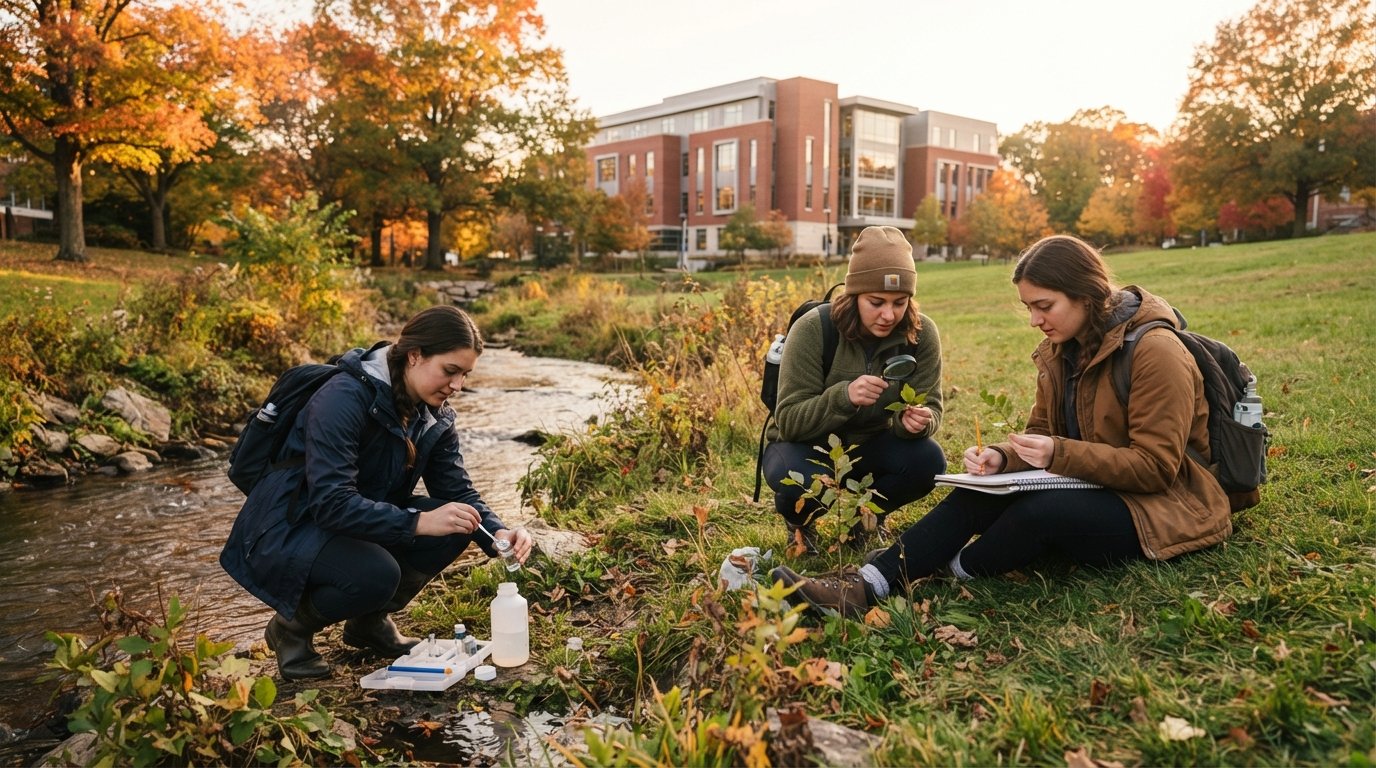
At Creighton, in-person study also means immersion in a campus culture shaped by Jesuit values, including a strong emphasis on service and ethical reflection. Environmental work is often collaborative and community-facing, and the campus setting reinforces those habits. You might find yourself sampling water quality at a nearby stream, presenting findings to a neighborhood group, or debating policy options in a seminar room, all in the same week.
For students weighing options beyond Nebraska, it helps to compare formats directly. Our guide on a four-year in-person biology degree explains how a traditional campus program structures science coursework, which can be a useful point of comparison when you evaluate environmental studies programs.
Admissions and Academic Preparation
Creighton reviews applicants holistically, weighing grades, test scores (where submitted), essays, and demonstrated interest in the field. A strong high school background in biology, chemistry, and mathematics is helpful, but so is evidence of curiosity: volunteer work with a conservation group, a science fair project, or a summer job outdoors.
Because the program is interdisciplinary, you do not need to arrive with your entire career mapped out. What matters more is a willingness to engage with both scientific and humanistic questions. Students who thrive tend to enjoy reading, writing, and quantitative reasoning in roughly equal measure.
If you are still exploring, a college matching service such as HigherEducationAdvisor can help you compare sponsored online and on-campus programs, browse schools by state, and request information without any obligation to apply. It is a useful first step before you narrow your list to a handful of campuses.
Career Outcomes After Graduation
Environmental studies graduates enter a wide range of fields. Some go into environmental consulting, where they help companies and municipalities comply with regulations and reduce their footprint. Others work for nonprofits, government agencies, or advocacy organizations focused on conservation and climate policy. A growing number move into corporate sustainability roles, where they track emissions, manage reporting, and advise on strategy.
Graduate study is another common path. Many alumni pursue master's degrees in environmental science, public policy, urban planning, or law, often after a few years of work experience. The interdisciplinary foundation of the bachelor's degree makes those transitions smoother, because you already know how to speak across disciplines.
Typical Roles and Settings
The list below reflects common entry points, though titles and responsibilities vary by employer and region.
- Environmental consultant: assess sites, prepare permits, and advise clients on compliance.
- Sustainability coordinator: track resource use and develop reduction plans for a university, hospital, or company.
- Policy analyst: research and draft recommendations for a government agency or legislative office.
- Conservation program associate: manage projects and volunteers for a land trust or watershed group.
- Environmental educator: design and deliver programs for schools, museums, or nature centers.
Salaries vary widely by sector, with consulting and corporate roles generally paying more at entry level than nonprofit or education positions. Over time, specialized skills such as GIS, environmental law, or data science tend to increase earning potential and open leadership tracks.
How to Decide If This Program Fits You
Choosing a college is a personal decision, and the right fit depends on your goals, your budget, and the kind of learning environment you want. If you value small classes, faculty mentorship, and a campus with a strong service ethos, Creighton's four-year, in-person model may align well. If you need to work full time or live far from Omaha, an online or hybrid option might be more practical.
A reasonable approach is to start broad, then narrow. Explore programs by subject and by state, note which ones match your priorities, and request information from a few. There is no cost or commitment to inquiring, and comparing responses can reveal differences in curriculum, financial aid, and career support that are hard to see from a website alone.
Finally, visit if you can. Sitting in on a class, meeting a professor, and walking the grounds tell you more than any brochure. Environmental studies is a field about places and people, and the campus where you spend four years becomes part of your professional story.
Whether you choose Creighton or another program, the decision is yours to make on your own timeline. Take the time to ask questions, compare options, and trust the fit that feels right for the next four years and beyond.