
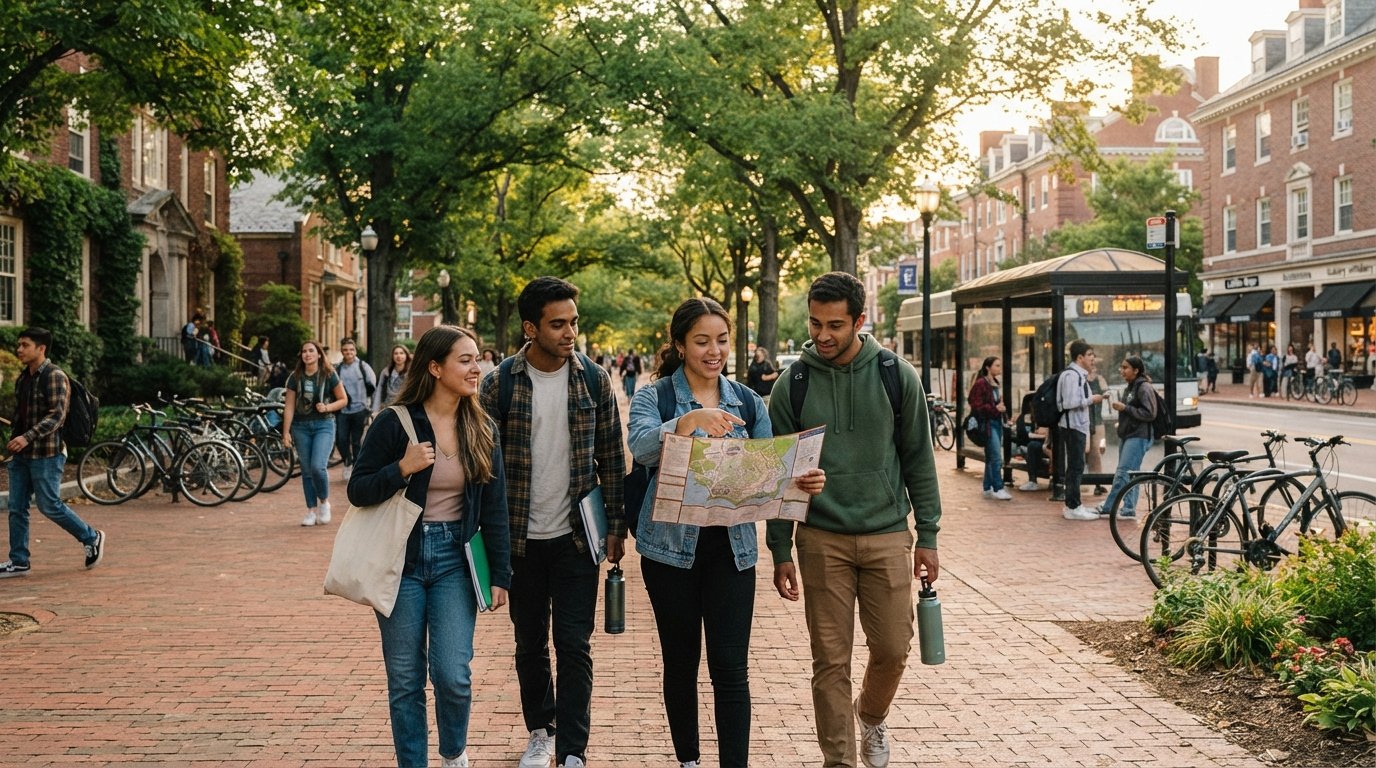
Exploring College Towns When Choosing an On-Campus Degree
Explore college towns before choosing an on-campus degree. Compare costs, transit, and jobs. Call 8772187081 for guidance on finding your best campus fit.

By Diana Tillotson
Choosing an on-campus degree is about more than picking a major or comparing tuition rates. The town or city surrounding your campus will shape your daily routines, your budget, your social life, and even your career pipeline for the next two to four years. Two schools can offer nearly identical programs in business or nursing, yet feel like completely different worlds once you factor in rent, transit, part-time job markets, and weekend culture. That is why exploring college towns when choosing an on-campus degree deserves the same careful research you give to faculty, accreditation, and financial aid.
This guide walks through a practical framework for evaluating campus communities before you commit. You will learn what to look for during a visit, how to weigh cost of living against opportunity, and how to use tools like HigherEducationAdvisor to compare sponsored programs in different regions. Whether you are a high school senior, an adult learner returning to school, or a career changer relocating for a new credential, the town you choose can accelerate or complicate your path. Treat the location as part of the degree itself.
Why the College Town Matters as Much as the Program
Prospective students often fixate on rankings and program length while treating location as an afterthought. That is a mistake. The surrounding community determines whether you can afford to live near campus, whether you need a car, how easily you can find internships, and whether you will actually enjoy the years you spend earning your degree. A program that looks perfect on paper can become a grind if the town has no affordable housing, unreliable transit, or few employers in your field.
Consider two students pursuing the same bachelor's degree in computer science. One enrolls in a mid-sized city with a growing tech corridor, paid internships, and a walkable downtown. The other enrolls in a rural town with limited local employers and no public transit. Same major, same tuition on paper, very different outcomes. The first student may graduate with a job offer and a professional network. The second may need to relocate immediately after graduation to find entry-level work. The town was not a backdrop; it was a factor in the return on investment.
College towns also influence your day-to-day well-being. Access to grocery stores, healthcare, gyms, libraries, and safe neighborhoods affects stress levels and academic performance. Social and cultural opportunities, from coffee shops to music venues to community sports, shape whether you feel connected or isolated. When you are exploring college towns when choosing an on-campus degree, you are really evaluating the environment that will support or strain your academic life.
What to Evaluate in a College Town Before You Commit
Start with a structured checklist rather than relying on gut feeling during a single campus tour. Most admissions offices show you the quad and the newest dorm, but they rarely walk you through the neighborhoods where students actually live or the bus routes they actually use. You need to do that legwork yourself, either in person or through careful online research.
Cost of living is usually the first filter. Rent, groceries, utilities, and parking can vary dramatically from one college town to another, even within the same state. A program in a high-cost metro area may require a larger loan or more work hours than a similar program in a smaller city. Before you fall in love with a campus, estimate a realistic monthly budget that includes housing, food, transportation, and personal expenses. Then compare that budget against typical student wages in the area.
Here are the core factors to investigate for any college town on your shortlist:
- Housing availability and cost: On-campus dorms, off-campus apartments, and commute distances from surrounding neighborhoods.
- Transportation: Public transit coverage, bike infrastructure, walkability, and whether you truly need a car.
- Local job market: Part-time work, internships, co-ops, and entry-level roles related to your field of study.
- Safety and neighborhood quality: Crime statistics, lighting, campus escort services, and student reviews of specific areas.
- Amenities and culture: Grocery stores, healthcare, recreation, nightlife, faith communities, and diversity of the population.
Once you have gathered data on these factors, rank them by what matters most to you. A student with a family may prioritize healthcare access and school districts. A first-year student may prioritize walkability and social opportunities. A career changer may prioritize internship density and professional networking. There is no universal best college town, only the best fit for your priorities, budget, and goals.
It also helps to compare on-campus and online options side by side, even if you are leaning toward a traditional campus experience. A college matching service such as TopStudents.com lets you browse sponsored programs by subject and state, so you can see how the same field of study plays out in different locations. That kind of comparison keeps you from committing to a town simply because it was the first campus you visited.
How to Research a College Town Without Visiting
Not everyone can afford the time or travel cost of multiple campus visits. Fortunately, you can learn a great deal about a college town from your laptop. Start with mapping tools to measure distances between campus, grocery stores, gyms, and likely apartment neighborhoods. Use street-level imagery to get a feel for commercial districts and residential blocks. Check transit authority websites for route maps and schedules, and confirm whether student IDs grant free or reduced fares.
Next, tap into student communities. Reddit threads, Discord servers, and university subreddits often contain candid discussions about housing, safety, professors, and local employers. Search for phrases like best neighborhoods near a specific campus or is a car necessary at a specific university. Read reviews with healthy skepticism, but pay attention to recurring themes. If multiple students mention that parking is impossible or that the nearest affordable grocery store is a 30-minute bus ride, that is useful signal.
Finally, use official and third-party data sources to verify your impressions. The U.S. Department of Education's College Scorecard provides graduation rates, median earnings, and average costs by institution. Local chambers of commerce and economic development websites list major employers and industries. City planning documents can reveal upcoming transit projects or neighborhood investments that may change the town in the next few years. Combining anecdotal student feedback with hard data gives you a more balanced picture than either source alone.
If you are comparing programs in several states, a matching platform can simplify the early stages of research. TopStudents.com, for example, organizes sponsored college listings by subject and by state, and it lets you request information from multiple schools without any obligation to apply or enroll. That can help you narrow your list to a handful of towns worth deeper investigation, whether you eventually visit in person or rely on virtual tours.
Timing Your Campus Visit Around the Town, Not Just the Tour
When you do visit, try to schedule your trip so you experience the town as a resident would, not just as a tourist on a guided tour. Weekday visits reveal commute patterns, class schedules, and the pace of local businesses. Weekend visits show you the social scene and whether the campus empties out when classes are not in session. If possible, do both.
Arrive a day early and stay overnight in a student neighborhood rather than a hotel near the highway. Eat where students eat, ride the bus or bike the route you would take to class, and walk through the grocery store you would actually shop at. Strike up conversations with current students about where they live, how they get around, and what they wish they had known before enrolling. These informal conversations often reveal more than any official presentation.
During your visit, ask specific questions that go beyond academics:
- What percentage of students live on campus versus off campus, and how does that change after freshman year?
- How do most students get to internships, clinical placements, or co-op sites, and does the school provide transportation?
- What is the typical monthly rent for a one-bedroom or shared apartment within walking distance of campus?
- How safe do students feel walking alone at night, and what safety resources does the campus provide?
- What do students do for fun off campus, and how easy is it to access those options without a car?
Take notes and photos, and compare your impressions across visits while they are still fresh. It is easy to confuse one beautiful quad with another after a few trips. A simple spreadsheet with columns for cost, transit, safety, job market, and culture can keep your evaluation grounded in evidence rather than emotion.
Balancing Cost of Living With Career Opportunity
One of the trickiest trade-offs in exploring college towns when choosing an on-campus degree is the relationship between cost of living and career opportunity. Towns with thriving job markets and strong internship pipelines often come with higher rents and other expenses. Towns with low costs may offer fewer local employers in your field, which can mean relocating after graduation or commuting long distances for relevant work experience.
There is no single right answer, but you can make the trade-off explicit. If your field requires extensive internships, clinical hours, or industry connections, a higher-cost town with a dense employer network may pay off through better job placement and higher starting salaries. If your field is more portable or you plan to return to your home region after graduation, a lower-cost town may let you graduate with less debt and more flexibility.
Consider also the hidden costs of a poor location fit. A town with no affordable housing near campus may force you into a long commute, which costs time, money, and energy that could go toward studying or networking. A town with limited part-time jobs may push you into higher loan balances. A town with few social or cultural outlets may affect your mental health and persistence. These factors do not show up in a tuition table, but they influence whether you finish your degree and how much it ultimately costs you.
When you compare programs, look beyond the sticker price. Estimate total cost of attendance, including housing, food, transportation, and fees, for each town on your list. Then estimate potential earnings from part-time work and internships in that area. The gap between those numbers is a more honest measure of affordability than tuition alone. A college matching service can help you gather program details quickly so you can focus your energy on these financial calculations.
Red Flags and Green Flags in a College Town
After you have researched several towns, patterns will start to emerge. Some characteristics consistently signal a supportive environment for students, while others suggest friction that could undermine your experience. Learning to recognize these flags can speed up your decision-making and reduce the risk of a costly mistake.
Green flags include a visible student presence throughout the town, not just on campus. Look for coffee shops, bookstores, and affordable eateries that cater to students year-round. Reliable public transit or bike infrastructure that connects campus to residential neighborhoods is another positive sign. A diverse local economy with employers in your field, plus a clear pipeline from the school to internships and entry-level jobs, suggests strong career support. Safe, well-lit neighborhoods within walking or biking distance of campus round out the picture.
Red flags include campuses that feel isolated from the surrounding community, with few options for housing, food, or recreation outside the university gates. Towns where students report feeling unwelcome or unsafe can signal deeper cultural friction. A lack of affordable housing near campus often leads to long commutes, higher costs, and lower engagement in campus life. If the local job market has little connection to your field, you may struggle to gain relevant experience before graduation. Finally, be cautious of towns where the cost of living is rising rapidly without corresponding growth in student wages or financial aid.
No town will be perfect, and some red flags may be acceptable trade-offs depending on your priorities. The goal is not to find a utopia but to make an informed choice. If you understand the trade-offs going in, you can plan around them, whether that means arranging a car, budgeting for higher rent, or seeking remote internships.
Using College Matching Tools to Compare Towns and Programs
Exploring college towns when choosing an on-campus degree involves juggling a lot of variables: program quality, cost, location, transit, safety, and career outcomes. A college matching service can reduce the administrative burden by organizing sponsored programs in one place and letting you filter by subject, degree level, and state. Instead of visiting dozens of individual university websites, you can compare key details side by side and request information from the schools that fit your criteria.
TopStudents.com is designed for exactly this stage of the search. You can browse colleges by state to see what is available in regions you are considering, or browse online programs by subject if you want to keep a remote option open. The platform does not grant credit and is not a college or university; it connects prospective students with participating schools. There is no obligation to apply or enroll after requesting information, which means you can explore widely without pressure.
As you narrow your list, use the platform to gather program details, then layer in your own research on the surrounding town. Combine what you learn from school listings with data from transit authorities, local employers, and student communities. That hybrid approach gives you both the academic and the environmental picture, which is exactly what you need to choose a campus where you can thrive.
Making the Final Call: Fit Over Prestige
When decision time arrives, resist the urge to choose based solely on name recognition or a single impressive campus tour. The best on-campus degree for you is the one you can afford, complete, and leverage into the next stage of your life. That usually means a program in a town where your daily needs are met, your budget is sustainable, and your career field has a presence.
Write down your top three priorities, whether they are low debt, strong internships, proximity to family, or a vibrant social scene. Then score each town and program against those priorities. If a school excels academically but the town fails on affordability or safety, be honest about whether you can manage that trade-off for two to four years. If a less prestigious program sits in a town with a strong job market and a cost of living you can handle, it may deliver a better long-term return.
Remember that the college town is not just a temporary address. It is where you will build routines, relationships, and professional connections that can last well beyond graduation. Taking the time to explore college towns when choosing an on-campus degree is an investment in your own success. With careful research, honest self-assessment, and the right comparison tools, you can find a campus community that supports both your education and your life beyond the classroom.