
Hair Styling Associate's Degree at Everett CC: 2-Year Guide
Explore the Hair Styling/Stylist and Hair Design Associate's degree, usually 2 years In-person at Everett Community College. Call 8772187081 for guidance.

By Alice Shaw
Cosmetology is a hands-on, people-centered field where artistry meets technical skill, and one of the most direct paths into it runs through a community college. The Hair Styling/Stylist and Hair Design Associate's degree, usually 2 years In-person at Everett Community College, gives students a structured, affordable route into salon work, editorial styling, and eventually salon ownership. For anyone weighing a private beauty academy against a public college program, this degree is worth a close look because it blends technical training with general education, business fundamentals, and transferable credentials.
Everett Community College sits in Everett, Washington, roughly 30 minutes north of Seattle. Its cosmetology program is designed for students who want to complete a recognized credential, prepare for state licensing exams, and enter the workforce with practical experience. Because the program is in-person, students get daily hands-on practice with real clients, which is essential in a field where touch, timing, and client communication matter as much as technique.
This guide walks through what the degree covers, who it suits, how to apply, what it costs, and what careers open up afterward. It also explains how to compare this program against other options using tools like the college matching service at TopStudents.com, which lets prospective students browse sponsored school listings by subject and state without any obligation to apply.
What the Hair Styling/Stylist and Hair Design Associate's Degree Covers
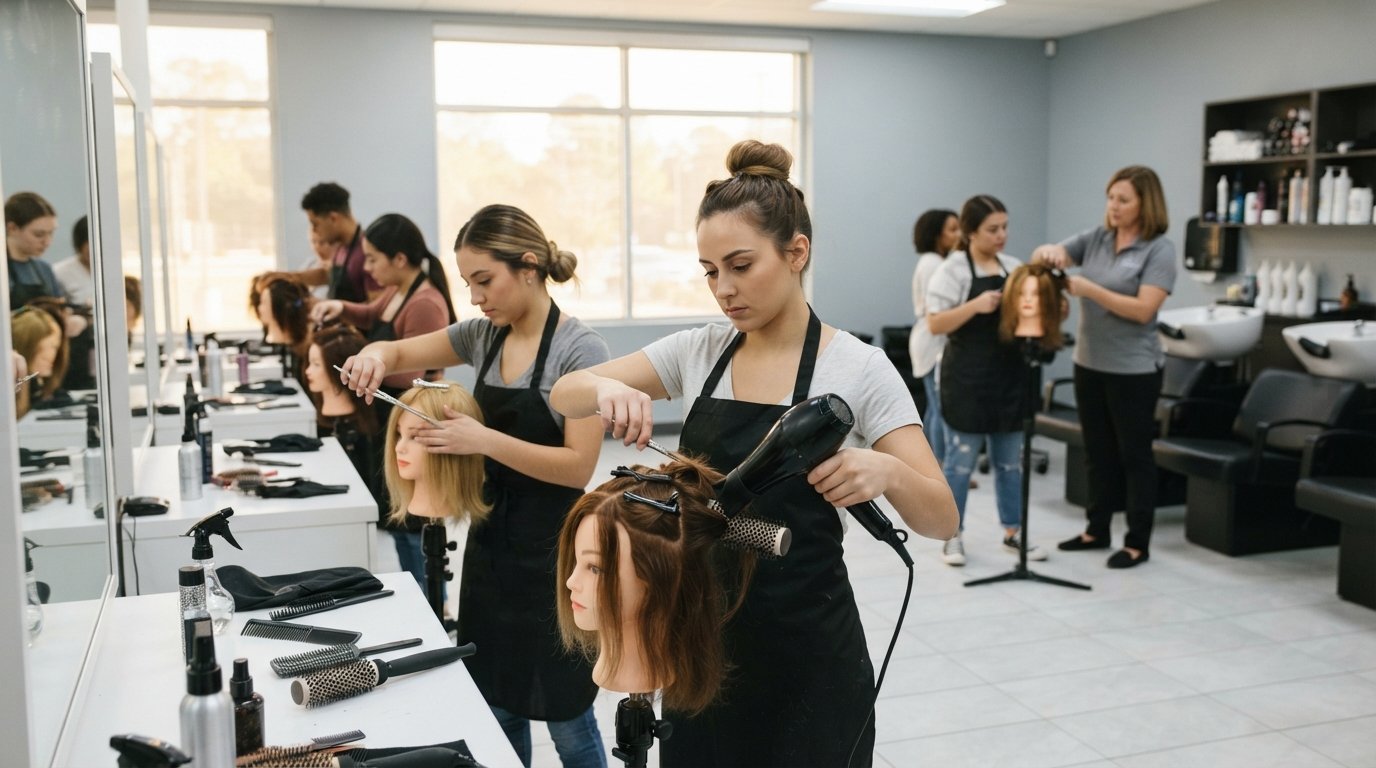
An associate's degree in hair styling and hair design is more than a licensing course. It typically combines 90 or more quarter credits across three broad areas: technical cosmetology skills, general education, and business or communications coursework. At Everett Community College, students spend significant time in a supervised salon lab, practicing on mannequins first and then on paying clients from the community.
Core technical training usually includes hair cutting, coloring, chemical texture services, shampooing and scalp care, blow-drying, styling, and updo work. Students also learn about hair and scalp disorders, sanitation, disinfection, and Washington state safety regulations. Because the program is in-person, instructors can correct hand positioning, tension, and sectioning in real time, which is hard to replicate in an online format.
Beyond the chair, the degree typically requires coursework in English composition, math, psychology, and business. These classes might feel unrelated to styling at first, but they build the communication and critical-thinking skills that salon owners and hiring managers consistently say they value. A stylist who can explain a color formula, manage a client consultation, and handle a scheduling conflict is more employable than one who only knows technique.
Business courses often cover retail management, marketing, and small business planning. That matters because many stylists eventually want to rent a booth, open a suite, or launch their own salon. Understanding pricing, inventory, and client retention early can shorten the path from employee to owner.
Typical Coursework at a Glance
While exact course titles vary, students in a two-year hair design associate's program can expect a mix of hands-on and academic classes. The following list reflects the general categories most programs include:
- Hair cutting and styling fundamentals, including layered, blunt, and textured cuts
- Color theory and application, covering highlights, balayage, and corrective color
- Chemical services such as perming, relaxing, and keratin treatments
- Salon business and retail operations, including client management and pricing
- General education courses in communication, math, and psychology
Students should expect to spend several hundred hours in the salon lab before graduation. Washington state requires a specific number of training hours before a student can sit for the licensing exam, and the associate's degree is structured to meet or exceed that threshold. That means graduates leave with both a diploma and exam eligibility, which is a meaningful advantage over shorter certificate programs that may not include general education.
Why Choose an In-Person Program at Everett Community College
Online cosmetology programs exist, but they cannot replace the tactile learning that happens when you hold a pair of shears, feel the tension of a section, or read a client's reaction in real time. The in-person format at Everett Community College is built around that reality. Students practice on real clients in a supervised salon, which builds confidence and speed before graduation.
Another advantage is cost. Community college tuition is typically far lower than private beauty school tuition, and students may qualify for federal financial aid, state grants, and scholarships. Everett Community College also offers advising and career services that help students navigate licensing paperwork, job searches, and transfer options if they want to pursue a bachelor's degree later in areas like business or education.
Location matters too. Everett sits in Snohomish County, with easy access to Seattle, Bellevue, and the broader Puget Sound job market. Salons, spas, and media companies in the region hire regularly, and students who build a client base during their training often have a head start on employment after graduation.
Campus vs. Online Learning: What Fits Hair Design
For hair design specifically, the campus experience is not just a preference; it is a requirement for licensure in most states. That said, some related coursework, such as business math or marketing, may be available online or in hybrid formats. Students who want flexibility should ask the program advisor which general education classes can be completed remotely.
Prospective students exploring other fields can compare online and campus options using a college matching platform. For example, those curious about digital careers can read this guide on an online web design associate's at Ana G. Mendez to see how a different creative degree handles the online format. The contrast helps clarify why hands-on fields like hair design remain campus-based.
Admissions, Costs, and Financial Aid
Admission to the hair styling and hair design associate's program at Everett Community College generally requires a high school diploma or equivalent, placement testing in reading and math, and completion of program-specific orientation. Some cohorts fill quickly, so early application is recommended. Students should also be prepared for a background check and health documentation, since the program involves direct client contact.
Costs include tuition, lab fees, a toolkit, textbooks, and licensing exam fees. Community college tuition is usually charged per credit, and students can estimate total program cost by multiplying the per-credit rate by the number of credits required. Financial aid options include federal Pell Grants, Washington state need grants, work-study, and institutional scholarships. The college's financial aid office can help students build a plan that avoids unnecessary debt.
It is also worth noting that many students work part-time while enrolled. Because the program is in-person and daytime-heavy, students should plan their work schedules around lab hours. Some salons hire students as receptionists or assistants, which can provide income and industry exposure at the same time.
For students who want to explore additional degree options or compare sponsored school listings, platforms like CheapOnlineEducation can help connect prospective learners with programs that match their budget and goals. These matching services are not colleges themselves, and there is no obligation to apply or enroll, but they can simplify the research phase.
Career Outcomes After Graduation
Graduates of the Hair Styling/Stylist and Hair Design Associate's degree, usually 2 years In-person at Everett Community College, are prepared for a range of entry-level and mid-level roles. The most common path is salon stylist, but the degree also opens doors to barbering, bridal and event styling, editorial work, and product education.
Income varies widely based on location, clientele, and commission structure. Stylists in busy urban salons can earn significantly more than those in small towns, and those who build a strong social media presence often attract higher-paying clients. Booth renters and suite owners keep a larger share of each service but pay rent and supply costs themselves.
Career progression often looks like this: start as a junior stylist or assistant, build a clientele, specialize in a high-demand service such as color or extensions, then move into a senior stylist or educator role. Some graduates eventually open their own salon or become distributors for product lines.
Potential Job Titles and Settings
Hair design graduates work in a variety of environments, each with its own pace and pay structure. The following list covers the most common settings:
- Full-service salons and day spas
- Barbershops and men's grooming lounges
- Bridal and event styling studios
- Film, television, and theater production teams
- Product education and sales for beauty brands
Each setting rewards different strengths. Salon work favors speed and client retention, while editorial and production work favors creativity and portfolio quality. Students should use their lab hours and internships to test which environment suits them best.
How to Succeed in the Program
Success in a two-year hair design program depends on more than talent. Attendance, practice hours, and client communication are the strongest predictors of how quickly graduates pass their licensing exam and find work. Students who treat the salon lab like a job, arriving early, staying late, and asking for feedback, tend to advance faster.
Building a professional portfolio during the program is also smart. Before-and-after photos, color formulas, and client testimonials can be used on social media and in job interviews. Many salons now hire based on Instagram or TikTok presence as much as technical skill, so students should start documenting their work early.
Finally, students should prepare for the licensing exam well before graduation. Study groups, practice tests, and instructor-led review sessions all help. The written exam covers sanitation, chemistry, and state law, while the practical exam tests real services under time pressure. Practicing under timed conditions in the lab reduces exam-day anxiety.
Comparing Everett CC to Other Options
Private beauty academies often promise faster completion, but they usually cost more and may not include general education credits. An associate's degree takes longer, typically two years, but it provides a broader education, better transfer options, and a credential that can support future roles in management or education.
Students who want to compare programs by subject, state, or format can use a college matching site to browse sponsored listings. These platforms do not guarantee admission or list every school, but they can help narrow the field and connect students directly with admissions representatives.
For those considering a different creative path, it also helps to look at how other programs structure their curriculum. The web design associate's program mentioned earlier is a useful comparison point because it shows how a creative field can be taught online, while hair design remains firmly campus-based.
Ultimately, the right program depends on budget, schedule, and career goals. The Hair Styling/Stylist and Hair Design Associate's degree, usually 2 years In-person at Everett Community College, is a strong fit for students who want hands-on training, a recognized credential, and a clear path to state licensure without the higher cost of a private academy.
If you are ready to explore programs, start by requesting information from schools that match your interests. There is no obligation to apply or enroll, and comparing multiple options is the best way to make a confident decision about your future in hair design.