
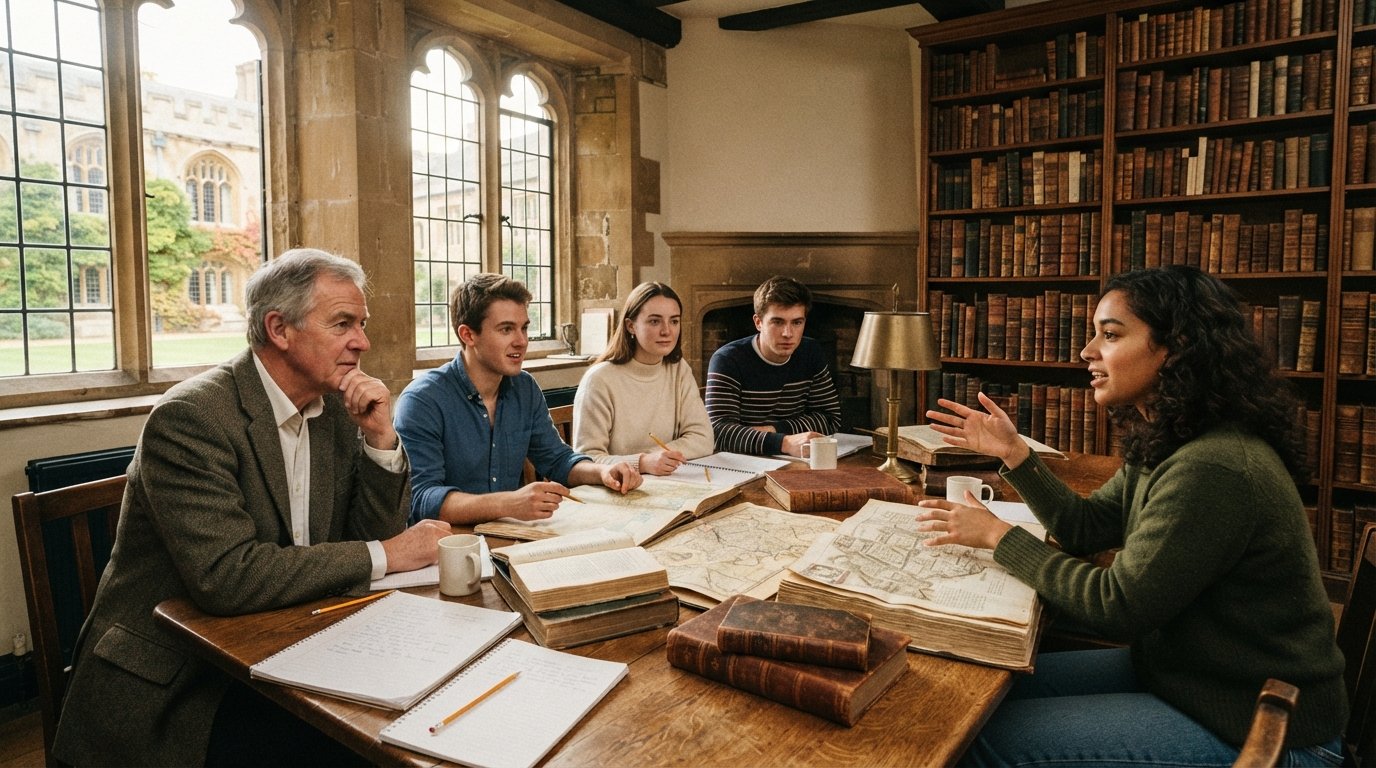
History, General Bachelor's at Caltech: 4-Year In-Person
A History, General Bachelor's degree, usually 4 years In-person at California Institute of Technology, blends rigorous humanities with a science-driven campus culture. See if it fits.

By Henry Lawson
What if the path to understanding humanity's past ran through one of the world's most storied science and engineering campuses? A History, General Bachelor's degree, usually 4 years In-person at California Institute of Technology, offers exactly that paradox: a rigorous humanities program embedded in a institution famous for physics, engineering, and the sciences. For students who crave deep historical inquiry but also want the intellectual intensity, small cohorts, and resources of a top-tier research university, this program presents a distinctive option worth exploring carefully.
Caltech is not the first name most people associate with history. Yet its undergraduate offerings include a history track that lets students examine political, social, and cultural change while developing analytical writing, research, and critical thinking skills that employers and graduate schools value. This article breaks down what the program entails, how the four-year in-person structure works, who it suits, and how to decide if it belongs on your shortlist. Along the way, we will connect the dots to broader degree exploration, including how platforms like TopStudents.com can help you compare options. If you are also weighing other four-year liberal arts paths, a related guide on a Music General Bachelor's Degree at CCSU shows how in-person arts and humanities programs differ across institutions.
Why a History Degree at Caltech Deserves a Closer Look
California Institute of Technology, commonly called Caltech, is a small private university in Pasadena, California, known for an exceptionally low student-to-faculty ratio and a culture of intense intellectual curiosity. Its undergraduate population is small, which means students in the humanities receive personal attention and seminar-style instruction rather than large lecture halls. A History, General Bachelor's degree, usually 4 years In-person at California Institute of Technology, fits within this environment as a humanities concentration that encourages students to ask big questions about power, culture, technology, and change over time.
The program is not a traditional standalone history department in the way a large state university might structure it. Instead, history at Caltech is typically offered through the Division of the Humanities and Social Sciences, where students can pursue a history option or a history-focused course of study alongside rigorous general education requirements. This means you will not escape quantitative reasoning or scientific literacy; you will integrate them with historical analysis. That combination is rare and valuable. Graduates emerge able to read primary sources critically, construct evidence-based arguments, and communicate complex ideas clearly, skills that translate into law, public policy, education, journalism, business, and graduate study.
Another reason to look closely is the in-person, four-year format. Residential college life at Caltech is famously close-knit, with house systems that foster lifelong networks. Learning face-to-face in small seminars means you debate interpretations with professors and peers, not just absorb lectures online. For students who thrive on discussion, mentorship, and access to archives, labs, and nearby cultural institutions in the Los Angeles area, the in-person experience is a major draw.
What the Four-Year, In-Person Structure Actually Involves
The phrase usually 4 years In-person signals a full-time residential undergraduate experience. At Caltech, the academic calendar runs on a quarter system, which means courses move quickly and students take fewer classes at a time but cover material intensively. A history-focused bachelor's degree typically blends core humanities seminars, historical methodology courses, topical electives, and a capstone or research project. Because Caltech requires a strong foundation in mathematics and the sciences for all undergraduates, history students also complete coursework that sharpens analytical and quantitative reasoning.
Here is a simplified view of how the four years often take shape for a history-oriented student:
- Year one: Foundational courses in writing, humanities, mathematics, and science, plus introductory history seminars that build reading and argumentation skills.
- Year two: Broader historical surveys and electives, exploration of related fields such as philosophy, political science, or literature, and early advising on a research focus.
- Year three: Upper-level history courses, methodology training, possible study abroad or archival research, and internship exploration.
- Year four: A capstone or senior thesis, advanced electives, and preparation for graduate school or the job market.
Because Caltech is small, course offerings in history may be more limited than at a large public university, but the depth and mentorship are substantial. Students often work closely with faculty on independent research. The in-person requirement also means access to Caltech's libraries, special collections, and the broader research ecosystem of Pasadena and Los Angeles, including museums, archives, and cultural organizations that support historical work.
Admissions and Academic Preparation
Admission to Caltech is highly selective regardless of major. Prospective history students should demonstrate strong writing and analytical skills alongside solid preparation in mathematics and science, since the core curriculum expects quantitative readiness. Extracurriculars that show curiosity, research, debate, or writing talent help. It is also wise to articulate why history within a science-focused institution appeals to you; admissions readers appreciate students who understand the distinctive fit rather than applying on prestige alone.
Cost, Financial Aid, and Value Considerations
Caltech is expensive on paper, but its financial aid program is among the most generous in the country, with need-based support that can significantly reduce or eliminate tuition for families with limited resources. Prospective students should run the net price calculator and compare aid packages carefully. The value question for a history degree is less about starting salary and more about long-term flexibility: strong writing, research, and reasoning skills open doors in law, education, public service, media, and business, and Caltech's brand and alumni network add meaningful weight to a resume.
Who Thrives in This Program, and Who Might Not
A History, General Bachelor's degree, usually 4 years In-person at California Institute of Technology, suits students who want a small, intense, residential college experience and who are comfortable crossing disciplinary boundaries. If you love reading primary sources, writing essays, debating interpretations, and also enjoy being around scientists and engineers, this could be an excellent fit. The program rewards intellectual versatility and self-direction.
On the other hand, students seeking a massive course catalog with dozens of history faculty specializing in every region and era may find Caltech's scale limiting. If you want a traditional large university history department with extensive elective variety, a public flagship or a liberal arts college with a deep history faculty might serve you better. Similarly, if you need fully online flexibility or part-time pacing, the in-person four-year format will not match your life circumstances.
It helps to ask yourself a few honest questions before applying:
- Do I want small seminars and close faculty mentorship more than a huge course catalog?
- Am I comfortable completing science and math requirements alongside history coursework?
- Do I value a residential campus culture and the Los Angeles-area location?
- Is my goal broad analytical preparation (law, policy, education, media) rather than a narrowly vocational credential?
If most answers point toward yes, Caltech's history pathway deserves serious consideration. If not, exploring other four-year in-person humanities programs through a college matching service can help you find a better-aligned institution.
Career Outcomes and Graduate Pathways
History graduates from elite institutions pursue a wide range of paths. Common destinations include law school, public policy and government, education and teaching, journalism and communications, nonprofit leadership, museums and archives, and business roles that demand strong writing and analysis. Caltech's alumni network and reputation can open doors, but the real asset is the skill set: the ability to research deeply, synthesize information, and argue persuasively.
For students considering graduate study, a history bachelor's provides a foundation for master's and doctoral programs in history, as well as professional degrees in law, public health, and business. Internships during the four years are important; Caltech students can pursue opportunities in Los Angeles and beyond, and faculty connections often help. It is also worth noting that the in-person format supports networking, recommendation letters, and research assistantships that are harder to replicate online.
If you are comparing this path with other in-person bachelor's options, resources such as HigherEducationAdvisor can help you explore sponsored online and on-campus degree and certificate programs, compare fields of study, and request information from schools without any obligation to apply. That kind of neutral exploration is useful before committing to a highly selective institution.
How to Decide If Caltech's History Program Fits Your Goals
Choosing a college is a matching problem, not a ranking problem. The best program is the one that fits your learning style, financial situation, career direction, and personal priorities. For a History, General Bachelor's degree, usually 4 years In-person at California Institute of Technology, the fit is strongest for students who want a small, rigorous, residential experience and who are excited by the idea of studying history in a science-driven environment.
A practical decision framework can help. First, clarify your goal: are you aiming for graduate study, law school, teaching, or a broad analytical career? Second, assess your learning preferences: seminars and mentorship versus large lectures and extensive electives. Third, evaluate finances using net price calculators and aid offers. Fourth, visit or attend virtual sessions to sense the campus culture. Finally, compare at least three to five programs side by side so you are choosing from evidence, not just reputation.
For students who want to broaden the search beyond a single institution, a college matching platform can streamline the process. TopStudents.com, for example, lets prospective students browse programs by subject and state, review sponsored listings, and request information from participating schools with no obligation to enroll. It is not a college or university and does not grant credit; it is a referral service that helps you explore options efficiently. Using such tools alongside direct research on Caltech's history pathway gives you a clearer picture of the landscape.
Ultimately, the value of a history degree lies in the habits of mind it builds: curiosity, evidence-based reasoning, and clear communication. At Caltech, those habits are sharpened in a small, intense, in-person community that few other institutions can replicate. If that combination excites you, the program is worth a serious look, and the four-year residential format may be exactly the environment where you do your best work.