
Industrial Electronics Certificate at EFSC: 12 Weeks to 1 Year
The Industrial Electronics Technology/Technician Certificate offers hands-on training in under a year. Call 8772187081 to explore this in-person program at EFSC.

By Maya Foster
Skilled industrial electronics technicians keep factories, power plants, and automated warehouses running. When a motor drive fails or a programmable logic controller loses its program, these professionals diagnose the problem fast and get production back online. If you want to enter this high-demand field without committing four years to a bachelor's degree, the Industrial Electronics Technology/Technician Certificate, offered in a format of 12 weeks to less than 1 year In-person at Eastern Florida State College, delivers hands-on training in a condensed timeframe. The program sits on the Titusville campus and prepares students for entry-level roles in manufacturing, aerospace, and energy across Florida's Space Coast. This guide breaks down what you learn, who hires graduates, how to pay for it, and how to decide whether this short-term credential fits your career plan.
Why Industrial Electronics Technicians Are in Demand
Modern production lines depend on sensors, robotics, and networked control systems. When any of those components fail, the cost of downtime can reach thousands of dollars per hour. Employers therefore prize technicians who can troubleshoot electrical circuits, read schematics, and program or repair automated equipment without waiting for an outside contractor. According to the U.S. Bureau of Labor Statistics, employment for electrical and electronics repairers in industrial settings is projected to remain steady, with openings driven largely by retirements and the ongoing adoption of automation.
Florida's manufacturing sector has expanded significantly, particularly along the Space Coast where aerospace suppliers, medical device makers, and food processing plants operate. Eastern Florida State College sits in the middle of that corridor, which means students train near the same facilities that hire graduates. Certificate holders often step into roles such as:
- Industrial electronics technician
- Maintenance technician
- Automation or controls assistant
- Field service technician for equipment vendors
- Electrical systems tester
These positions typically pay above the state median for entry-level work and offer clear pathways to specialization. A technician who learns robotics or instrumentation can move into higher-paying roles without returning to school full time, because many employers fund additional certifications once someone is on staff.
What the Certificate Covers
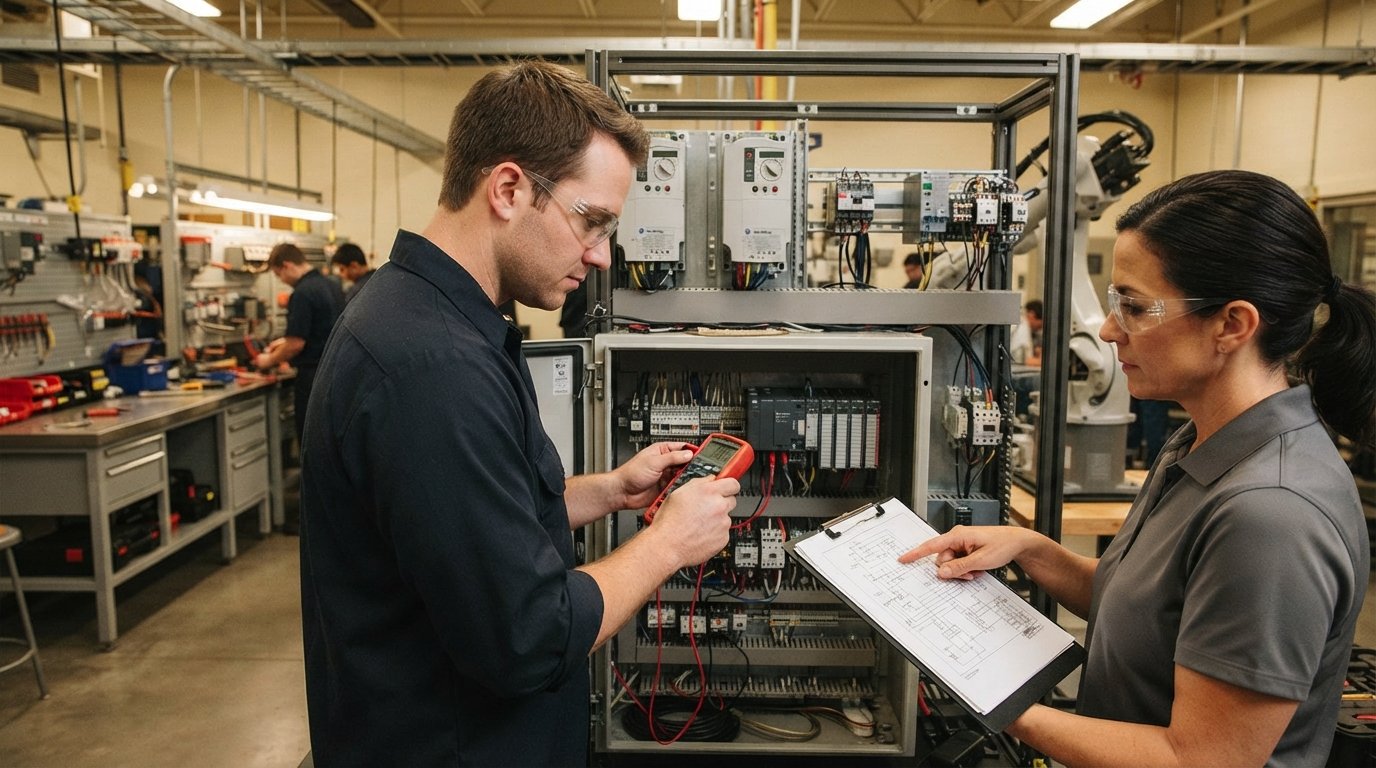
The Industrial Electronics Technology/Technician Certificate is built around practical skills rather than general education courses. Students spend the bulk of their time in labs, wiring circuits, testing components, and troubleshooting faults under instructor supervision. The curriculum usually includes direct current and alternating current theory, solid-state devices, digital logic, motor controls, and programmable logic controllers. Because the program runs in person, learners get immediate feedback when a circuit does not behave as expected, which is difficult to replicate in an online-only format.
Coursework typically progresses from foundational electrical theory to advanced control systems. A student might begin by learning how to use a multimeter and oscilloscope, then move into relay logic and ladder diagrams, and finally program a PLC to run a simulated conveyor or sorting station. Safety practices, including lockout/tagout procedures and proper grounding, are woven throughout because industrial environments demand strict adherence to electrical codes.
By the end of the certificate, graduates should be able to read and interpret electrical schematics, diagnose faults in motor control circuits, configure basic PLC programs, and document their work according to industry standards. These competencies align with what hiring managers list in job postings for maintenance and controls roles. For students who want to compare this credential with other short-term options, our guide on the Nail Technician Certificate: 12 Weeks at Beaver Beauty Academy illustrates how different fields structure accelerated training, which can help you weigh trade-offs between program length, cost, and earning potential.
Format, Schedule, and Location
The program is delivered entirely in person, which matters for a hands-on discipline like electronics. Lab equipment, test benches, and instructor demonstrations are central to learning, and students benefit from working alongside classmates who may already be employed in maintenance roles. The 12-weeks-to-less-than-1-year range reflects the fact that some learners complete the certificate in a single accelerated term, while others spread courses across two or three terms depending on course availability and personal scheduling.
Eastern Florida State College offers the certificate through its Titusville campus, home to the college's aerospace and advanced manufacturing programs. That location gives students access to dedicated electronics labs and instructors with industry experience. Because classes are face to face, students should plan for daytime or evening sessions and arrange transportation accordingly. Prospective students who need flexibility may want to ask an advisor whether any courses articulate into an associate degree, since that pathway can allow part-time study after the certificate is earned.
Compared with a full associate degree, the certificate requires fewer credit hours and focuses narrowly on technical competencies. That makes it attractive for career changers who want to enter the workforce quickly, as well as for incumbent workers who need formal credentials to qualify for a promotion. The trade-off is that a certificate may not transfer as broadly as a degree if you later decide to pursue a bachelor's in engineering technology, so it pays to clarify your long-term goals before enrolling.
Admissions Steps and Practical Preparation
Admission to a certificate program at a Florida state college is generally less competitive than admission to a selective university. Applicants typically need a high school diploma or equivalent, and they may need to take a placement test or provide ACT or SAT scores to determine readiness for college-level math and English. Because the program involves electrical work, students should also be prepared for the physical aspects of lab training, including standing for extended periods and handling tools and small components.
Here is a practical sequence that most applicants follow:
- Complete the online application to Eastern Florida State College and pay any application fee.
- Submit official high school transcripts or GED documentation.
- Take the placement test or submit qualifying test scores.
- Meet with an academic advisor to confirm the certificate track and plan course sequence.
- Register for classes and secure any required tools or safety equipment.
After registration, students should confirm the lab schedule and any prerequisite courses. Some programs require a basic electricity course before advanced PLC work, so skipping ahead is not advisable. Advisors can also explain whether prior military training or industry experience qualifies for credit, which can shorten the time to completion.
Cost, Financial Aid, and Return on Investment
Tuition for Florida resident students at a state college is among the lowest in the country, and certificate programs usually cost a fraction of a bachelor's degree. Additional expenses include textbooks, a calculator, safety glasses, and possibly a basic tool kit. Students should budget for these items early because lab courses may require them in the first week.
Financial aid options for certificate seekers include federal Pell Grants, Florida student assistance grants, and institutional scholarships. Veterans may qualify for GI Bill benefits, and some employers offer tuition reimbursement for workers who pursue credentials related to their current jobs. Because the program is short, even a modest grant can cover a large share of the total cost. To estimate your return on investment, compare the total program cost against the starting wages for maintenance technician roles in your area. In many Florida markets, entry-level industrial electronics technicians earn enough to recoup certificate costs within the first year of employment.
Prospective students who want to compare programs, request information, and explore related fields can use a college matching service such as HigherEducationAdvisor to browse sponsored online and on-campus options without any obligation to apply. That kind of research helps you confirm that the EFSC certificate aligns with your budget and career target before you commit.
Career Outcomes and Next Steps After Graduation
Graduates of the Industrial Electronics Technology/Technician Certificate typically enter the workforce directly, though some continue into an associate degree in engineering technology. Entry-level roles often involve preventive maintenance, troubleshooting production equipment, and assisting senior technicians with installations. With a year or two of experience, technicians can specialize in robotics, instrumentation, or controls engineering support, and some move into supervisory positions.
Certification can also strengthen a resume for employers in aerospace, pharmaceutical manufacturing, and food processing, all of which operate in Central Florida. Because automation continues to spread, the skills learned in this program remain relevant even as specific equipment models change. Technicians who keep learning, whether through employer training or additional college coursework, tend to advance fastest.
If you are ready to explore this path, start by contacting Eastern Florida State College to confirm current start dates, lab availability, and any changes to the certificate requirements. Then compare the program with other short-term technical credentials using a matching platform so you can make an informed decision. With careful planning, the Industrial Electronics Technology/Technician Certificate can move you from curiosity to a paycheck in less than a year.