
Machinist Associate's Degree at Cowley: 2-Year Guide
Explore the Machine Tool Technology/Machinist Associate's degree at Cowley, a 2-year in-person path to machining careers. Call 8772187081 for guidance.

By Wendy Reed
A machinist turns a block of raw metal into a finished part that fits a machine, an engine, or a surgical tool. That transformation does not happen by accident. It comes from reading blueprints, calculating dimensions, setting up lathes and mills, and holding tolerances measured in thousandths of an inch. If that kind of precision work appeals to you, a Machine Tool Technology/Machinist Associate's degree, usually 2 years In-person at Cowley County Community College, offers one of the most direct routes into the trade. Cowley County Community College, often called Cowley College, has built its machine tool program around hands-on training in real shop environments, and the two-year structure gives you enough repetition to walk into an entry-level machinist job with genuine confidence.
What makes this degree worth a closer look is the format itself. Machine tool technology is one of the few fields where online learning cannot fully substitute for the shop floor. You need to feel the resistance of a cutting tool, hear when a speed is wrong, and measure a part with calipers in your own hands. Cowley's in-person model is not a limitation; it is the point. Employers in manufacturing know the difference between someone who has watched a video about CNC setup and someone who has crashed a tool, corrected the offset, and run the part again. This article walks through what the program covers, what it costs in time and money, what careers it opens, and how to decide whether it fits your goals.
What the Machine Tool Technology Program at Cowley Actually Teaches
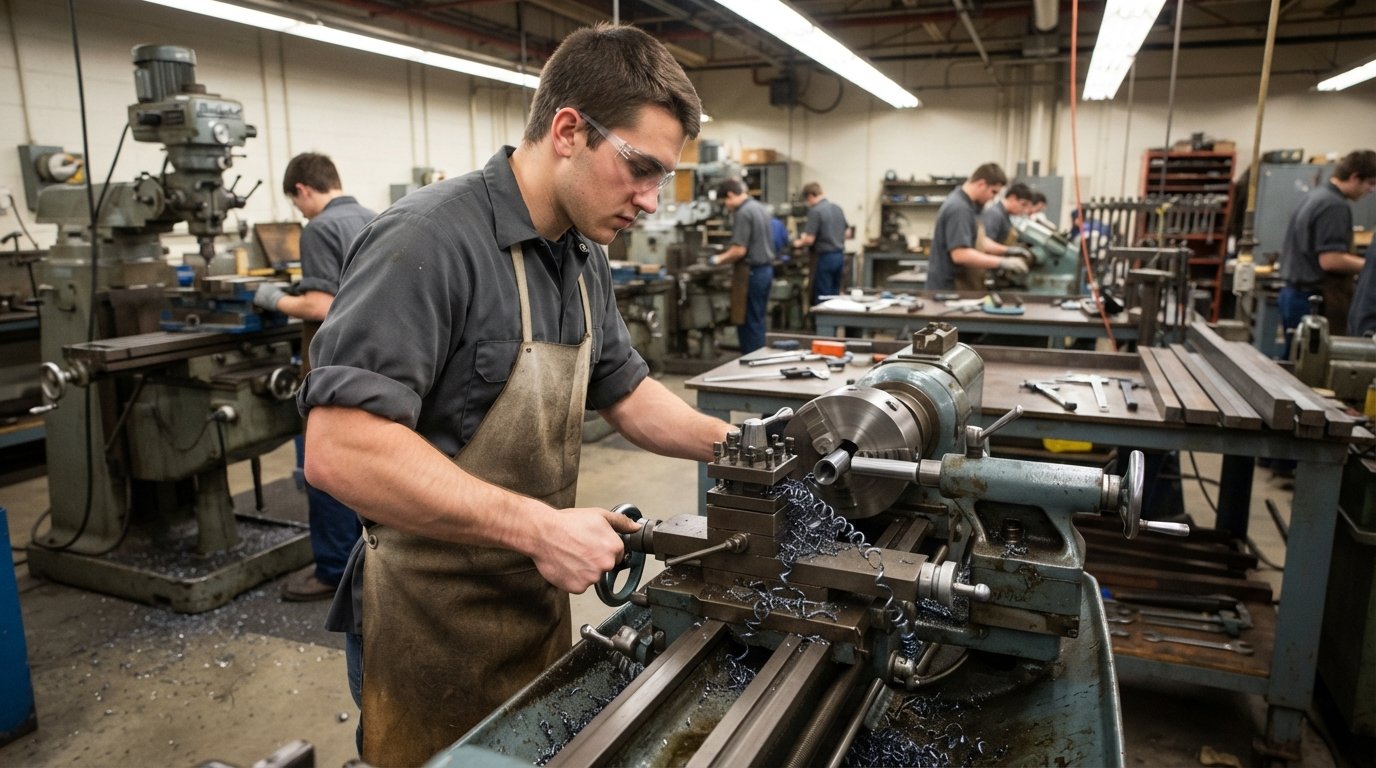
The core of any machinist associate's degree is the same: manual machining first, computer numerical control (CNC) second, and inspection throughout. Cowley structures its machine tool technology coursework so that students learn the fundamentals on conventional lathes, milling machines, drill presses, and surface grinders before moving to CNC equipment. That sequence matters. When you understand how a manual mill removes metal, you can troubleshoot a CNC program far faster because you recognize what the machine is trying to do and why it might fail.
Coursework typically blends technical classroom instruction with extensive lab hours. Students learn to interpret engineering drawings, apply geometric dimensioning and tolerancing (GD&T), select cutting tools and speeds, and work with metals ranging from aluminum and mild steel to harder alloys. Safety is woven through every lab because machine shops punish carelessness quickly. By the end of the program, a graduate should be able to plan a machining sequence, set up a machine, produce a part to print, and inspect it for quality.
CNC training usually covers programming, setup, and operation, often including both turning centers and machining centers. Many programs also introduce CAD/CAM software, where students design a part digitally and generate the code that drives the machine. This is where modern machinists spend a growing share of their time, and it is a skill that separates graduates who get hired quickly from those who struggle.
Here is a representative snapshot of what you can expect to study across the two years:
- Blueprint reading and engineering drawing interpretation, including GD&T symbols and tolerances
- Manual lathe and milling machine operation, including turning, facing, threading, and boring
- CNC programming and setup for mills and lathes, with hands-on machine time
- CAD/CAM software for part design and toolpath generation
- Precision measurement and quality inspection using micrometers, calipers, and gauges
- Shop safety, print reading, and materials science fundamentals
Beyond the technical list, the program builds habits that employers notice: patience, attention to detail, and the discipline to check your work rather than assume it is correct. Those habits are hard to teach in a classroom and easy to build in a shop that runs five days a week.
Why In-Person Training Matters for Machinists
Plenty of careers have moved online, and many degrees now offer flexible remote options. Machining is not one of them, at least not at the entry level. The reason is simple: machining is a physical skill. You develop it the way you develop any physical skill, through repetition under supervision. A student who spends two years in a shop, making chips and correcting mistakes, arrives at a job with muscle memory that a remote learner simply cannot replicate.
In-person training also gives you access to equipment you would never own yourself. Industrial lathes, CNC machining centers, and metrology tools cost tens of thousands of dollars. A community college shop lets you use them daily, with instructors who can stop you before a mistake becomes an injury or a scrapped part. That supervised practice is the real value of the degree.
There is also the matter of employer expectations. Manufacturing companies hiring machinists often want to see that you have run real machines, not simulations. A transcript from an in-person program tells them you have stood at a machine for hundreds of hours. That credibility shortens your job search and can raise your starting wage.
If you are comparing formats for other fields, the trade-off looks different. In our guide to a General Studies Associate's Degree: 2-Year In-Person at CGCC, we explain how a broad two-year foundation can transfer into a bachelor's program, which is a very different path from the hands-on precision of machine tool technology. Both are valid; they simply serve different goals.
Time Commitment, Cost, and What to Expect
The degree is designed to be completed in about two years of full-time study, which usually means four or five semesters depending on course sequencing and whether you need developmental coursework first. Students who attend part-time or work while enrolled often stretch it to three years. Either way, the structure is built around scheduled lab time, so flexibility is limited compared to a fully online program.
Costs vary by residency and financial aid package. As a public community college, Cowley typically offers lower tuition for in-district and in-state students, with higher rates for out-of-state residents. Beyond tuition, you should budget for tools, safety equipment, and possibly a personal set of measuring instruments. Many programs provide access to shared tools, but owning your own calipers and micrometers is common practice and often expected in the workplace.
Financial aid options generally include federal grants, loans, work-study, and scholarships, and community college programs often qualify for workforce development funding. Because machinist training is considered a high-demand technical field, some states and local manufacturers sponsor students directly. It is worth asking the program coordinator about scholarships tied to local employers.
To plan realistically, consider these common cost categories:
- Tuition and fees, which vary by residency status
- Books, prints, and course materials
- Personal measuring tools and safety gear (safety glasses, boots, calipers)
- Transportation and parking, since lab attendance is mandatory and frequent
- Possible tool kit requirements for advanced courses
One advantage of the two-year timeline is that it gets you earning sooner than a four-year degree while still providing a credential that employers recognize. You are not paying for two extra years of general education unless you choose to pursue a bachelor's later. For many students, that trade-off is exactly right.
Career Outcomes and Earning Potential for Machinists
Machinists are in demand, and the demand is not going away. Manufacturing in the United States depends on skilled workers who can make and repair precision parts, and the workforce is aging. As experienced machinists retire, employers struggle to replace them. That shortage works in your favor when you graduate with a two-year degree and hands-on training.
Entry-level roles for graduates include machinist, CNC operator, CNC setup technician, tool and die apprentice, and quality inspector. With a few years of experience, many machinists move into programming, process planning, or shop supervision. Others specialize in aerospace, medical devices, energy, or automotive work, where tolerances are tight and pay reflects the difficulty.
Earnings vary widely by region, industry, and skill level. Entry-level machinists often start in a range that supports a solid middle-class lifestyle, and pay rises quickly with proven ability. CNC programmers and tool and die makers tend to earn more because their skills are harder to replace. Overtime is common in manufacturing, which can substantially increase annual income for those who want it.
If you want to compare this path with other technical fields, an education matching service such as HigherEducationAdvisor can help you explore sponsored programs and request information from schools without any obligation to enroll. It is a useful starting point if you are still deciding between machining, welding, electronics, or another trade.
Long-term, the degree also opens doors to further education. Some machinists pursue engineering technology bachelor's degrees, move into manufacturing management, or start their own machine shops. The two-year credential is a foundation, not a ceiling.
Admission Steps and How to Get Started
Getting into a machine tool technology program is generally straightforward. Community colleges typically require a high school diploma or equivalent, and some programs ask for placement testing in math and reading. Because machining involves calculations, a comfort level with basic algebra and geometry helps, but you do not need to be a math expert to start. Programs usually build the math you need into the coursework.
The application process tends to follow a predictable sequence. Knowing the steps in advance keeps you from missing deadlines or scrambling for documents.
- Complete the college application and submit transcripts from high school and any prior colleges.
- Take placement tests or submit ACT/SAT scores if required for course placement.
- Meet with an advisor or program coordinator to map out your course sequence.
- Apply for financial aid by completing the FAFSA and any local scholarship applications.
- Register for classes early, since lab sections fill quickly and sequencing matters.
Once enrolled, treat the program like a job. Show up on time, keep your tools organized, and ask questions when you do not understand a setup. Instructors notice the students who take it seriously, and those relationships often turn into job leads. Local manufacturers frequently call program coordinators when they need new hires, so being known as a reliable student is a real advantage.
If you are also considering a broader two-year path, a college matching service can help you compare sponsored listings by subject and state. You can browse options, review program details, and request information directly from schools that fit your goals, all without any obligation to apply or enroll.
Is the Machinist Associate's Degree Right for You?
This degree suits people who like working with their hands, solving concrete problems, and seeing a finished product at the end of the day. It rewards patience and precision more than speed, and it offers a clear path to employment without a four-year commitment. If you enjoy building, fixing, and measuring, and you want a skill that travels across industries, machine tool technology is a strong fit.
It is less suited to people who want fully remote work or who dislike repetitive practice. Machining requires repetition to build skill, and the shop environment is noisy, physical, and unforgiving of shortcuts. But for the right student, that environment is exactly where they thrive.
A Machine Tool Technology/Machinist Associate's degree, usually 2 years In-person at Cowley County Community College, is a practical investment in a durable career. You graduate with a credential employers recognize, skills you can demonstrate, and a pathway into an industry that needs workers. If precision work appeals to you, the next step is simple: contact the program, ask about start dates and costs, and visit the shop. Seeing the machines in person usually settles the question.