
Pipefitting and Sprinkler Fitter Certificate in Under 12 Weeks
The Pipefitting/Pipefitter and Sprinkler Fitter Certificate at Digital Workforce Academy takes under 12 weeks in person. Call 8772187081 to explore enrollment.

By Alice Shaw
Skilled trades remain one of the most reliable paths into stable, well-paying work, and pipefitting sits near the top of that list. The Pipefitting/Pipefitter and Sprinkler Fitter Certificate, less than 12 weeks In-person at Digital Workforce Academy is built for people who want a fast, hands-on route into construction and fire protection systems without spending years in a classroom. If you are weighing a career change, finishing high school, or looking to add a credential that employers actually recognize, this short program deserves a close look.
Digital Workforce Academy delivers the training in person, which matters in this field. Pipefitting is physical, technical, and safety-driven work. You learn it by handling pipe, reading drawings, and practicing joints, not by watching slideshows. In under three months, the certificate aims to move you from curious beginner to job-ready candidate for entry-level roles in mechanical piping and sprinkler systems.
What the Pipefitting and Sprinkler Fitter Certificate Covers
The curriculum blends two related trades that often overlap on job sites. Pipefitters install and maintain piping systems that carry water, steam, chemicals, and gases in buildings and industrial facilities. Sprinkler fitters specialize in fire protection systems, the networks of pipe and heads that suppress fires in commercial buildings, warehouses, schools, and hospitals. Training in both areas widens the range of jobs you can pursue.
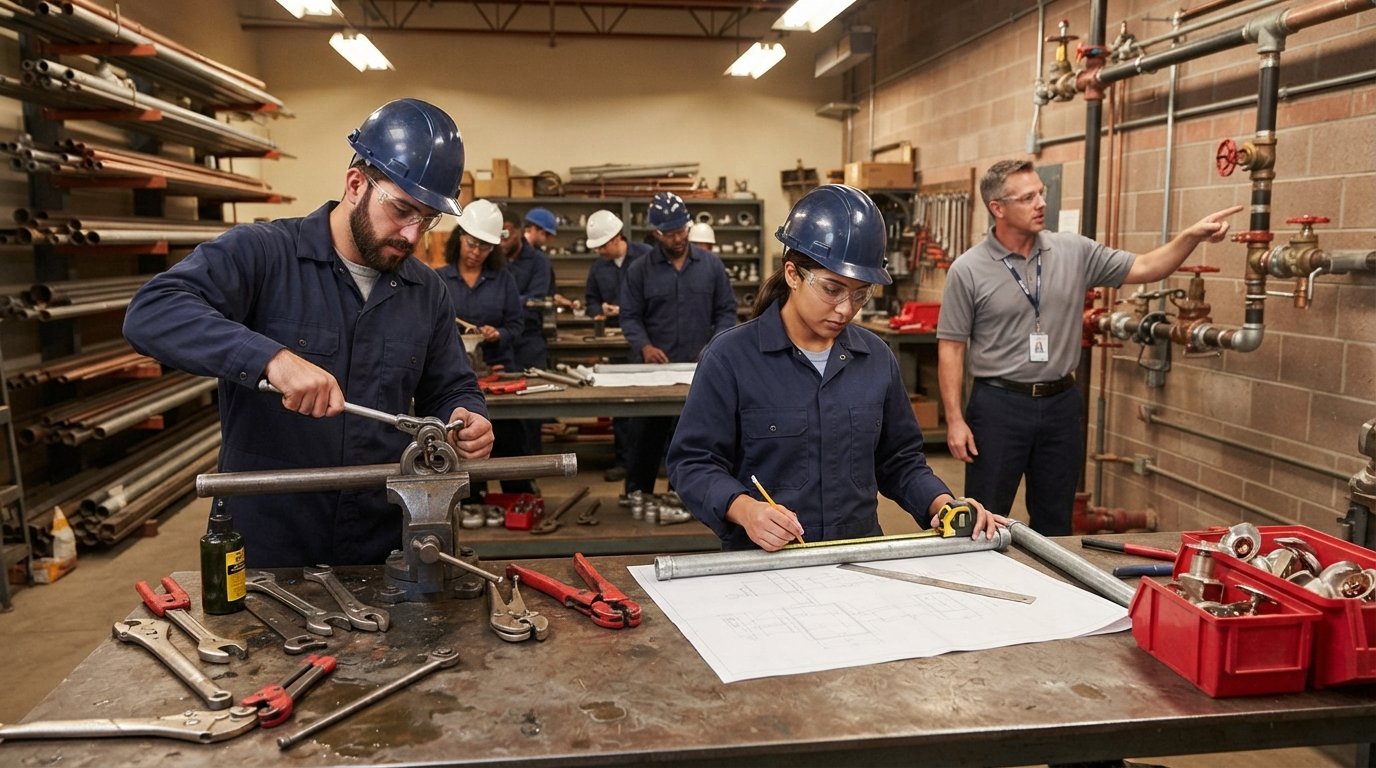
Students typically move through a sequence that starts with safety and tool basics, then builds toward layout, assembly, and testing. Because the program runs in person, instructors can correct your technique immediately, which reduces bad habits that are hard to unlearn later. Here is a representative snapshot of what the certificate introduces:
- Occupational safety, personal protective equipment, and jobsite hazard awareness
- Pipe materials, fittings, valves, and the tools used to cut, thread, and join them
- Reading and interpreting isometric drawings, blueprints, and specifications
- Soldering, brazing, welding basics, and mechanical joining methods
- Fire sprinkler system types, layout principles, and code fundamentals
That combination gives graduates a foundation they can take into an apprenticeship or entry-level helper position. Employers in the trades frequently say the same thing: they can teach the specific systems a company uses, but they cannot teach someone to show up safely, read a drawing, and handle tools with confidence. A focused certificate addresses exactly those baseline skills.
It also helps to understand how this credential fits into the broader landscape of short-term training. If you are still comparing options across fields, a resource like this guide to IT certificates that lead to entry level tech jobs shows how other industries structure fast credentials, which can help you judge whether a trade path matches your goals.
Why Less Than 12 Weeks Changes the Math
Time is the hidden cost of most education decisions. A two-year degree delays income, and a four-year degree delays it longer. A program that finishes in under 12 weeks compresses the front end of your career change so you can start earning, apprenticing, or applying while your skills are fresh. For adults with bills, that speed is not a gimmick; it is the whole point.
Short timelines also lower the total tuition exposure. Even when you borrow or pay out of pocket, a smaller program means a smaller balance to manage. Many trade employers offer tuition assistance or reimbursement once you are hired, and some union apprenticeship programs count prior training toward your standing. The certificate does not replace an apprenticeship, but it can shorten the runway to one.
There is a practical rhythm to a 12-week schedule as well. In-person classes keep you accountable, and a fixed end date keeps motivation high. You are not drifting through an open-ended online course. You are showing up, practicing, and finishing on a calendar that you can plan your life around.
In-Person Training and the Skills Employers Test
Hiring in the trades still runs heavily on demonstrated ability. Interviewers ask what you have built, joined, or installed. They watch how you handle a tape measure, a level, and a pipe wrench. In-person instruction at Digital Workforce Academy is structured around that reality, with hands-on repetitions that build muscle memory and judgment.
Classroom and lab time also create the informal signals employers trust: punctuality, teamwork, and the ability to take direction. Instructors who have worked in the field can speak to your reliability when you list them as references. That kind of recommendation carries weight that a certificate alone cannot.
Safety deserves special mention. Fire protection and piping work involve confined spaces, heights, hot work, and pressurized systems. Learning safe procedures under supervision, before you are on a paid jobsite, protects you and makes you more employable. Employers screen for safety awareness early because accidents are expensive and preventable.
Career Paths After the Certificate
Graduates typically enter through helper, apprentice, or trainee roles and advance as they accumulate hours and pass exams. The path is progressive, and each step raises your rate. Common starting points include residential and commercial plumbing-adjacent work, mechanical contracting, fire protection installation, and industrial maintenance support.
Over time, experienced pipefitters and sprinkler fitters can move into foreman roles, inspection and testing positions, estimating, or self-employment. Some specialize in specific systems such as high-pressure steam, process piping, or deluge and foam fire suppression. Certifications and licenses vary by state, so check local requirements early and plan your next credential accordingly.
If you want to compare how short credentials stack up against longer programs before committing, a matching service such as HigherEducationAdvisor lets prospective students browse sponsored online and on-campus options and request information without any obligation to enroll. That can be useful when you are deciding between a trade certificate and a degree path in the same field.
How to Enroll and Succeed in the Program
Admission to a workforce certificate is usually straightforward. Programs of this type generally look for a high school diploma or equivalent, basic math and reading ability, and the physical capacity to work in the trade. Some schools ask for a placement assessment or a brief interview to confirm fit. Because seats in hands-on cohorts are limited, applying early gives you more scheduling choices.
Before your first day, prepare the way you would for a job. Gather steel-toe boots, safety glasses, and work gloves if the program requires them. Review basic fractions and measurements, since pipe layout depends on accurate math. Arrange transportation and childcare in advance, because missed lab hours are hard to make up in a compressed schedule.
Once class begins, treat it like employment. Show up early, ask questions, take notes on drawings, and volunteer for extra practice. The students who get hired fastest are rarely the most naturally talented; they are the ones instructors trust. A 12-week program is short enough that every week of effort compounds quickly.
Is This Certificate Right for You?
This path suits people who like working with their hands, solving spatial problems, and seeing a finished system at the end of the day. It also suits anyone who needs a faster route to income than a traditional degree provides. If you dislike confined spaces, extreme temperatures, or physical labor, the trades may not be a fit, and it is better to learn that before enrolling than after.
For the right person, though, the outlook is encouraging. Buildings need piping and fire protection regardless of the economy, and experienced workers are retiring faster than new ones enter. A certificate in under 12 weeks will not make you a master fitter, but it can get you into the industry, onto a crew, and onto a pay scale, which is where real careers in this trade begin.