
Truck and Bus Driver Certificate in Under 12 Weeks at Flagler Tech
The Truck and Bus Driver/Commercial Vehicle Operator and Instructor Certificate at Flagler Technical Institute can get you licensed and job-ready in under 12 weeks.

By Diana Tillotson
Finding a fast, affordable path into a stable career can feel overwhelming, especially when you want hands-on training without spending years in a classroom. For people in Florida who are ready to earn a commercial driver's license and start working quickly, the Truck and Bus Driver/Commercial Vehicle Operator and Instructor Certificate, less than 12 weeks In-person at Flagler Technical Institute is one of the most direct routes available. This program combines behind-the-wheel practice, classroom instruction, and instructor preparation in a single short-term certificate, which means you can move from learner to licensed operator in a matter of weeks rather than semesters.
Flagler Technical Institute is a public technical center in Palm Coast, Florida, and its CDL programs are designed around employer demand. The Truck and Bus Driver/Commercial Vehicle Operator and Instructor Certificate, less than 12 weeks In-person at Flagler Technical Institute, appeals to career changers, recent high school graduates, and current drivers who want to add an instructor endorsement. Because the training is in person, students get real seat time, live feedback from certified instructors, and direct exposure to the pre-trip inspections and safety routines that Florida employers expect.
What This CDL Certificate Program Covers
The certificate is built around three connected skill sets: driving a commercial vehicle safely, passing the state licensing exams, and teaching others to do the same. Classroom modules cover federal motor carrier safety regulations, hours-of-service rules, map reading, and logbook procedures. Behind-the-wheel sessions focus on vehicle control, shifting, backing, turning, and lane management in both rural and urban traffic. Instructor-track students also study teaching methods, student evaluation, and how to structure a behind-the-wheel lesson plan.
Students typically train on Class A tractor-trailers and Class B vehicles such as buses and straight trucks, depending on the endorsement path they choose. The program prepares learners for the written general knowledge test, the air brakes test, the combination vehicles test when applicable, and the skills test administered by the state. Because everything happens on campus and on the road, students build muscle memory and confidence that online-only courses simply cannot replicate.
A typical week blends morning classroom blocks with afternoon driving rotations, and the schedule is intense by design. Here is how the main components break down:
- Classroom instruction: safety regulations, vehicle systems, cargo handling, and pre-trip inspection procedures
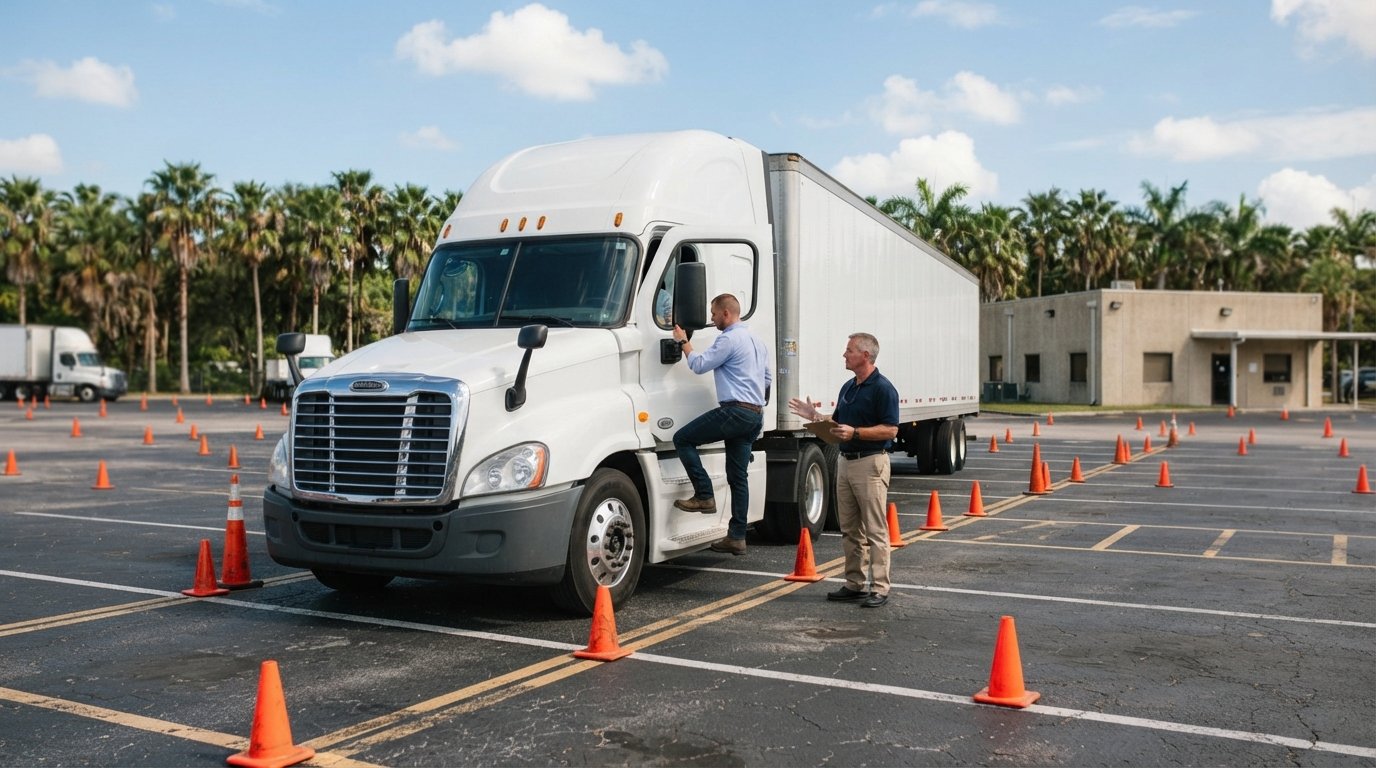
- Range practice: backing, offset maneuvers, parallel parking, and alley docking on a closed course
- Road driving: highway, city, and night driving with a certified instructor beside you
- Instructor preparation: lesson planning, student assessment, and coaching techniques for future trainers
- Exam readiness: practice tests, mock skills evaluations, and paperwork guidance for the Florida CDL process
Each of these components builds on the last. Students who complete the range and road portions usually find the state skills test far less intimidating because they have already performed the same maneuvers dozens of times under supervision. The instructor preparation portion is what separates this certificate from a standard CDL course, since it opens the door to teaching roles at driving schools, community programs, and fleet training departments.
Why the Under-12-Week Format Works
Speed matters when you are paying tuition and stepping away from a paycheck. A program that finishes in less than 12 weeks limits the time you spend out of the workforce and gets you earning sooner. It also creates momentum: daily repetition in a compressed schedule tends to produce faster skill retention than a drawn-out course that meets once a week. Employers who hire CDL drivers often prefer graduates from accelerated programs because the training mirrors the pace of real freight and transit schedules.
The in-person requirement is another advantage. Driving is a physical skill, and no video module can teach you how a loaded trailer responds when you brake on a wet road. Having an instructor in the cab means mistakes get corrected immediately, before they become habits. It also means you practice with the same equipment and inspection standards you will face on the job.
For anyone comparing options, it helps to weigh the tradeoffs honestly. Accelerated in-person training demands full attention and reliable transportation to campus, but it delivers credentialing faster than most alternatives. If you are exploring other short-term credential paths as well, resources like this guide to earning a CDL instructor certificate quickly can help you compare timelines and requirements across programs before you commit.
Admission Steps and What to Prepare
Enrollment at Flagler Technical Institute follows a straightforward sequence, but a few requirements trip up unprepared applicants. You generally need to be at least 18 years old for intrastate driving and 21 for interstate work, hold a valid Florida driver's license, and pass a Department of Transportation physical exam and drug screen. A clean driving record helps, and some endorsements require additional background checks.
Before classes begin, most students obtain a commercial learner's permit by passing the general knowledge and air brakes written exams at a Florida DMV office. The school typically provides study materials and practice tests to prepare for these. Tuition and fees vary by cohort, and financial aid options may include workforce grants, veteran benefits, or payment plans, so it is worth speaking with the admissions office early.
Here is a practical sequence most applicants follow:
- Confirm eligibility (age, license, driving record) and complete the DOT physical and drug screen
- Apply to Flagler Technical Institute and submit residency and identification documents
- Study for and pass the commercial learner's permit written exams
- Secure funding through grants, payment plans, or employer sponsorship
- Attend orientation, receive your training schedule, and begin class
Applicants who line up their physical, permit, and funding before the first day tend to breeze through orientation. Those who wait often lose a week or more catching up on paperwork while their classmates are already on the range.
Career Outcomes and Earning Potential
Graduates leave with a credential that qualifies them for several roles. Many start as local delivery drivers, bus operators, or regional freight drivers, while others move directly into instructor positions at driving schools or corporate training programs. Demand for qualified commercial drivers remains strong across Florida, particularly in logistics hubs near Jacksonville, Orlando, and Miami.
Entry-level pay varies by route type, endorsements, and employer, but CDL holders generally earn more than workers in many other short-term certificate fields. Instructor roles can pay a premium because they require both driving skill and teaching ability, and experienced trainers sometimes move into safety director or fleet manager positions. Because the certificate is short and the field is hiring, the return on investment can be measured in months rather than years.
It also helps to think beyond the first job. A CDL with passenger, school bus, or hazardous materials endorsements widens your options considerably. Some drivers use their experience as a stepping stone into dispatching, warehouse supervision, or owner-operator businesses. The instructor track, in particular, gives you a fallback that does not depend on long-haul schedules, which matters for people who want to stay close to home.
How to Choose the Right Training Path
Not every prospective student needs the same program. If your goal is simply to drive, a standard CDL course may be enough. If you want to teach, inspect, or supervise, the instructor certificate adds value that employers recognize. Before enrolling, visit the campus, meet an instructor, and ask about pass rates, job placement support, and the specific vehicles you will train on.
It is also wise to compare this program against other options in the region and online. Platforms such as HigherEducationAdvisor let you browse certificate and degree programs by field and format so you can see how a short-term CDL certificate stacks up against related credentials. The key is to match the program length, cost, and hands-on hours to your schedule and career goal, not just to pick the first listing you find.
Finally, talk to people who have finished the program. Former students can tell you how intense the schedule really is, how quickly they found work, and what they wish they had known beforehand. That kind of ground-level feedback is often more useful than any brochure.
The Truck and Bus Driver/Commercial Vehicle Operator and Instructor Certificate, less than 12 weeks In-person at Flagler Technical Institute, is a practical choice for anyone who wants to enter the transportation industry quickly and with real skills. Between the compressed timeline, the hands-on instruction, and the instructor credential, it offers a clear path from beginner to employed professional in a single season.