
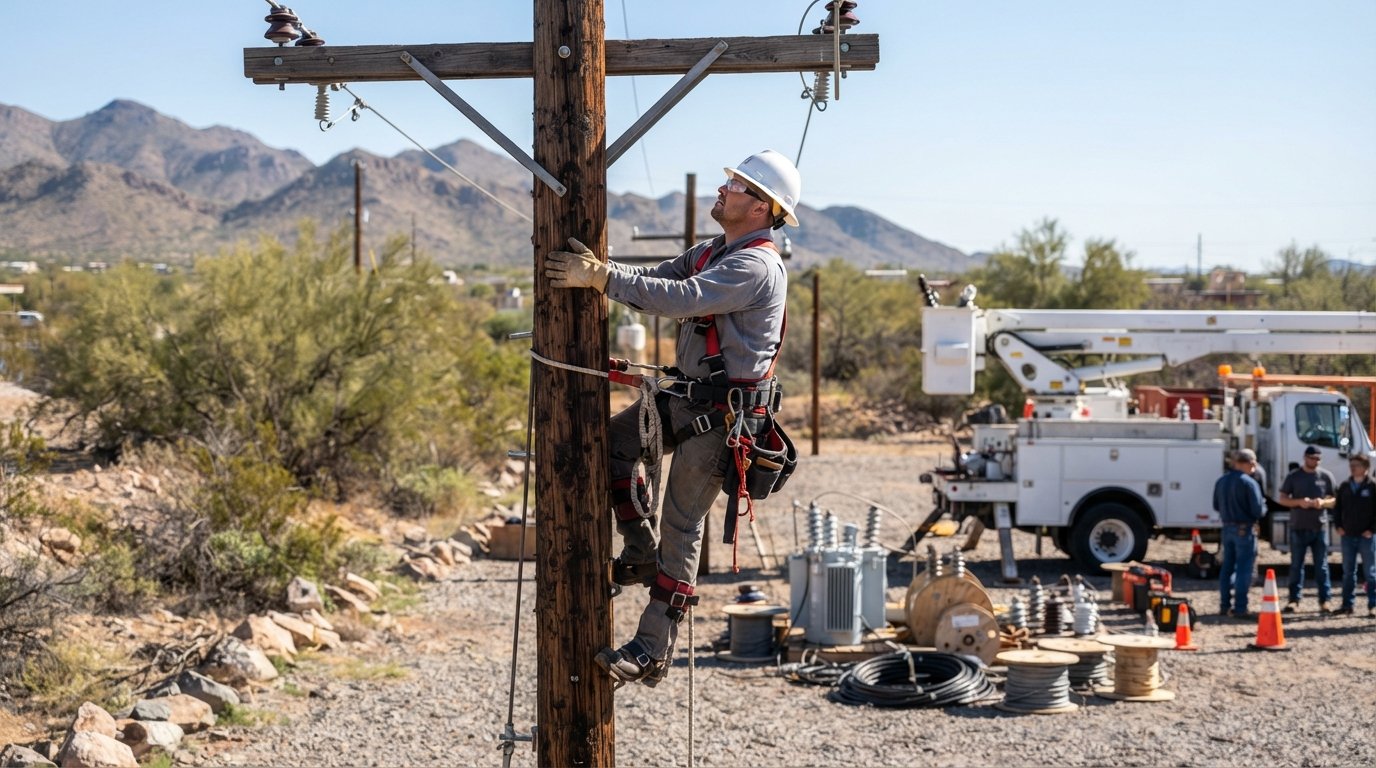
Lineworker Certificate at Dona Ana Community College
The Lineworker Certificate at Dona Ana Community College runs 12 weeks to under 1 year with hybrid online and in-person training for utility careers.

By Frederick Hill
Linemen keep the lights on. They climb poles in storms, repair downed lines after wildfires, and string the cable that powers hospitals, homes, and data centers. If you have ever watched a bucket truck roll past at 2 a.m. and wondered how someone gets that job, the answer often starts with a short, focused certificate. At Dona Ana Community College, part of the New Mexico State University system, the Lineworker Certificate offers a fast route into one of the country's most durable skilled trades. The program runs from 12 weeks to less than 1 year, mixes in-person and online coursework, and sits inside a state that needs utility crews year-round. This guide walks through what the certificate covers, who it fits, how the hybrid format works, and how to decide whether it belongs in your plan.
What the Lineworker Certificate Covers
Linework is not a single skill. It is a bundle of competencies that range from the physical (climbing, rigging, rescue) to the technical (electrical theory, transformer connections, print reading) to the procedural (safety standards, lockout/tagout, bucket truck operation). The certificate is built to touch all of these areas in a compressed timeline so graduates can interview for entry-level helper and apprentice roles without spending two or four years in a classroom.
The curriculum typically blends classroom instruction with hands-on practice. Online modules handle the conceptual material: electrical fundamentals, OSHA regulations, pole-top rescue theory, and the math behind voltage drop. In-person sessions, usually held at a training yard, cover climbing technique, knot tying, cover-up procedures, and simulated emergency scenarios. Because linework is a safety-critical trade, the hands-on hours matter as much as the reading. Employers want to see that you can handle a pole, not just describe one.
Students can expect coursework in these areas:
- Electrical theory and AC/DC fundamentals, including series and parallel circuits
- Pole climbing, fall protection, and bucket truck operation
- Overhead and underground distribution systems
- Transformer connections and basic troubleshooting
- OSHA safety standards, CPR, and first aid certification
- Print reading and utility mapping basics
Completion usually leads to a certificate rather than a degree, which keeps the cost and time commitment lower. That matters for career changers who already have bills to pay. Many students stack the certificate with a Commercial Driver's License (CDL), since utilities and contractors frequently require one for driving bucket trucks and material haulers. Adding a CDL can extend the timeline slightly, but it widens the job pool considerably.
The Hybrid Format: Online Plus In-Person Training
The mix of online and in-person delivery is one of the program's practical advantages. Online coursework removes the commute for lecture-heavy topics and lets students review electrical theory videos, safety briefings, and quizzes on their own schedule. That flexibility helps people who are working part-time, raising children, or driving in from rural communities around Las Cruces and the Mesilla Valley.
In-person sessions concentrate on what cannot be taught through a screen. Climbing a 40-foot pole requires muscle memory, balance, and comfort with height. Rigging a transformer requires hands on hardware. Instructors at a training yard can correct your posture, check your knots, and run you through rescue drills in real time. This division of labor is why hybrid lineworker programs have grown: they preserve the safety-critical practice while trimming the hours spent in a traditional classroom.
Prospective students should ask a few questions before enrolling. How many in-person days per week are required? Is equipment provided, or do students need their own climbing gear and boots? Are evening or weekend yard sessions available for working adults? What certifications (OSHA 10, CPR, flagger) are included, and which cost extra? Clear answers to these questions prevent surprises halfway through the term.
The compressed timeline, 12 weeks to less than 1 year, is another feature worth weighing. A 12-week track is intense and best suited to students who can treat the program like a full-time job. A longer track spreads the same material across two or three semesters, which can be easier to combine with employment. Neither path is inherently better; the right choice depends on how much time and money you can commit up front.
Admissions, Costs, and What to Bring
Community college certificate programs generally have open or lightly selective admissions compared with four-year engineering degrees. Applicants typically need a high school diploma or equivalent, a valid driver's license, and the ability to pass a basic math and reading assessment. Some programs require a physical examination or a drug screen because of the safety demands of the trade. It also helps to be comfortable working outdoors in heat, cold, and wind, since New Mexico weather does not pause for class schedules.
Costs vary by residency and by how many terms you take. In-district students usually pay less per credit hour than out-of-state students, and the certificate itself costs far less than an associate degree. Financial aid, workforce development grants, and employer sponsorships sometimes cover part or all of the tuition. Utility companies occasionally partner with community colleges to recruit and fund trainees, so it is worth asking the program coordinator about current partnerships before assuming you must pay everything yourself.
A realistic pre-enrollment checklist looks like this:
- Confirm residency status and estimate tuition for your specific track length.
- Complete the FAFSA and ask about workforce or trade-specific scholarships.
- Verify whether a CDL or drug screen is required before or after enrollment.
- Purchase or confirm required personal protective equipment (boots, gloves, hard hat).
- Talk to the program advisor about in-person attendance expectations and scheduling.
One more consideration: physical readiness. Linework rewards students who arrive with basic fitness. You do not need to be an athlete, but grip strength, core stability, and comfort with heights will make the climbing weeks far less painful. If you have time before the term starts, a simple strength and mobility routine pays off.
Students who want to compare this kind of hands-on credential with other trade programs can explore similar options through matching services. For example, a CNC machinist certificate program follows a comparable short-term, skills-first model, and reviewing that structure can help you judge whether linework or another trade better matches your interests. Broader education matching platforms such as HigherEducationAdvisor also let prospective students compare sponsored online and on-campus certificate and degree programs, request information from participating schools, and weigh options without any obligation to apply or enroll.
Career Outcomes and Why the Trade Endures
Electricity demand is not shrinking. Data centers, electric vehicles, heat pumps, and grid modernization projects all require more transmission and distribution capacity, and someone has to build and maintain it. Utilities across the Southwest report difficulty filling lineworker roles, partly because the work is physically demanding and partly because a wave of experienced linemen is retiring. That gap creates opportunity for certificate graduates who are willing to travel, work overtime, and start at the bottom of an apprenticeship.
Entry-level pay varies by employer, region, and union status, but linework generally pays above the median for jobs that do not require a bachelor's degree. Apprentices earn while they learn, and journey-level linemen can reach six-figure earnings with overtime and storm assignments. The trade also travels well: certifications and experience earned in New Mexico can transfer to utilities in other states, and storm restoration work can take crews across the country.
Typical starting roles after a certificate include:
- Groundman or line helper on a distribution crew
- Apprentice lineman with a utility or contractor
- Underground utility technician
- Meter technician or substation helper
- Vegetation management crew member supporting right-of-way work
Those roles are not glamorous at the start. Groundmen dig holes, load material, and learn by watching. But the apprenticeship ladder is well defined, and each step adds pay and responsibility. Within three to five years, a committed apprentice can reach journey-level status, and from there the paths branch into crew leadership, safety inspection, training, or utility operations.
It is also worth noting what the certificate does not do. It does not replace a formal apprenticeship, which most utilities require for journey-level status. It does not guarantee a job. And it does not suit everyone: if you dislike heights, extreme weather, or early-morning callouts, the trade will wear you down. The certificate is a launch point, not a finish line.
How to Decide If This Program Fits You
Start with an honest inventory of your constraints. How much time can you devote to in-person training each week? Can you afford to be out of work for 12 weeks, or do you need a longer track that fits around a job? Are you willing to relocate or travel for storm work, or do you want to stay near Las Cruces? The answers will point toward either the accelerated or extended version of the certificate.
Next, talk to people already in the trade. Call a local utility, a contracting company, or the union hall and ask what they look for in entry-level hires. Many will say the same things: a clean driving record, a CDL, physical fitness, and a safety-first attitude. A certificate plus a CDL plus a good interview often beats a certificate alone.
Finally, visit the campus if you can. Walk the training yard, look at the poles and equipment, and ask current students what the hardest week was. That visit will tell you more than any brochure. If the program feels like a fit, apply early, since cohort sizes in hands-on trades are often capped by equipment and instructor ratios.
Linework is one of the few careers where a short certificate can lead to a stable, well-paid, union-eligible job that cannot be outsourced or automated away. The Lineworker Certificate at Dona Ana Community College of NMSU gives students a compressed, hybrid path into that world, with online theory and in-person practice packed into 12 weeks to less than 1 year. For the right student, it is a practical on-ramp to a trade that keeps the country running.